
Table of Contents
Imagine a patient who has consulted a family physician in Jaipur, undergone heart surgery in Mumbai, received chemotherapy in Delhi, and later visited an emergency department in Bengaluru. Every hospital has pieces of the patient’s medical history, yet none has the complete picture. Doctors repeat investigations, patients struggle to recall past treatments, and valuable clinical information is often lost between healthcare providers.
This fragmentation has been one of the greatest challenges facing healthcare systems worldwide.
Today, healthcare is undergoing a digital transformation where information is becoming as important as medicine itself. The focus is no longer limited to storing hospital records electronically it is about creating a continuous health journey for every individual. This is where Vertical Health Records (VHRs) and Longitudinal Health Records (LHRs) become central to the future of healthcare.
India’s Ayushman Bharat Digital Mission (ABDM) is accelerating this transformation by creating a nationwide digital health ecosystem that enables the secure sharing of health information, with the patient’s consent, across hospitals, laboratories, pharmacies, insurers, and healthcare providers. Rather than viewing every hospital visit as an isolated event, the healthcare system begins to understand the patient’s entire medical journey.
Understanding Vertical Health Records.
A Vertical Health Record refers to health information that exists within a single healthcare organization or a specific episode of care. It includes all medical information generated during a patient’s interaction with one hospital, clinic, laboratory, or healthcare provider.
For example, if a patient undergoes knee replacement surgery at a tertiary hospital, the hospital maintains records of consultations, investigations, surgery notes, nursing observations, medication history, discharge summaries, and follow-up visits. These records provide a comprehensive view of care delivered within that institution but usually remain confined to that organization’s information system.
Vertical records are extremely valuable for managing day-to-day clinical operations, maintaining legal documentation, supporting quality improvement initiatives, and ensuring continuity of care within the same hospital. However, they become less useful when patients seek treatment elsewhere, as other healthcare providers may not have access to these records.
What Is a Longitudinal Health Record?
A Longitudinal Health Record takes healthcare documentation one step further. Instead of focusing on a single hospital or episode of care, it creates a lifelong, continuously updated digital record that follows an individual across multiple healthcare providers, cities, and stages of life.
A Longitudinal Health Record brings together an individual’s complete health journey into a single, continuously updated digital record. Instead of documenting only one hospital visit, it captures health information across different stages of life from childhood immunizations and family medical history to allergies, chronic illnesses, laboratory investigations, imaging reports, surgeries, hospital admissions, medications, preventive health checkups, pregnancy-related care, and even emergency treatments. As new medical events occur, the record grows over time, creating a comprehensive and accurate picture of a person’s health that can be securely accessed, with the individual’s consent, by authorized healthcare providers whenever and wherever care is needed.
Rather than asking, “What happened during this hospital visit?”, a longitudinal record answers a much broader question:
“What is the complete health story of this individual?”
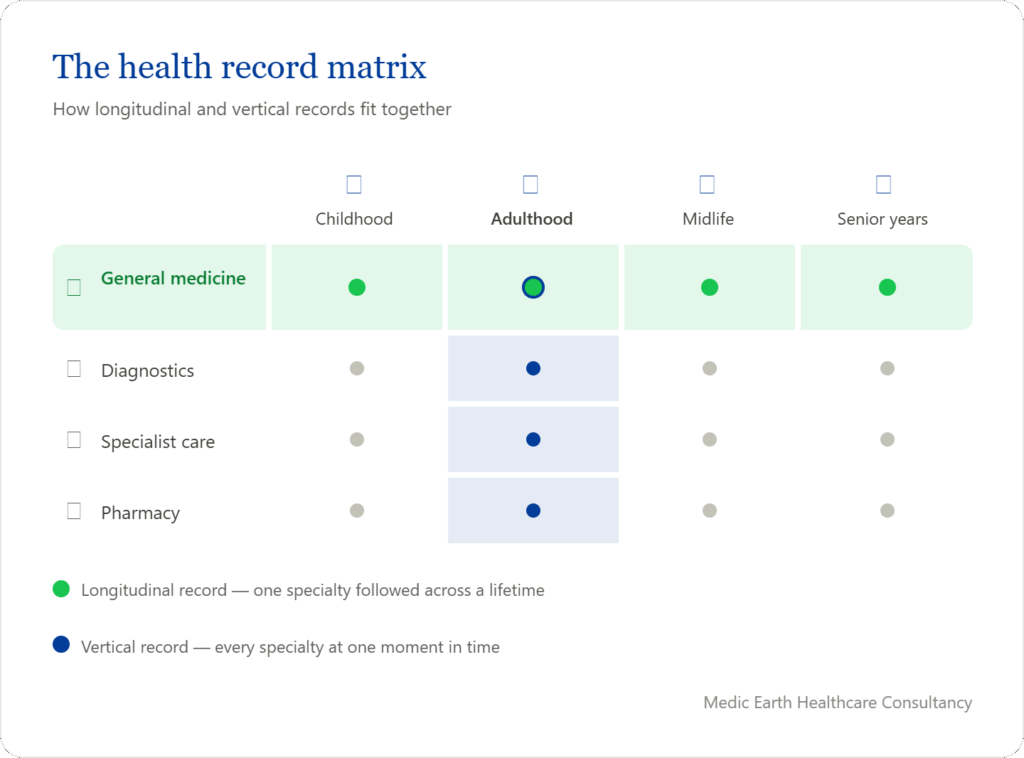
Vertical vs Longitudinal Health Records
| Vertical Health Record | Longitudinal Health Record |
| Limited to one hospital or provider | Spans multiple healthcare providers |
| Episode-based | Lifetime-based |
| Institution-centric | Patient-centric |
| Supports local clinical care | Supports coordinated healthcare |
| Information remains siloed | Information is securely connected |
| Useful within one organization | Useful across the healthcare ecosystem |
Why Longitudinal Health Records Matter.
Modern medicine increasingly relies on complete information rather than isolated clinical encounters.
Consider an elderly patient with diabetes, hypertension, kidney disease, and a previous stroke. If admitted unconscious after an accident, immediate access to medication history, allergies, previous imaging, laboratory reports, and chronic disease records can significantly improve clinical decision-making.
Similarly, a pregnant woman moving between cities need not repeat investigations if her antenatal records are securely available through a longitudinal health record. A cancer survivor receiving follow-up care can benefit when every treating specialist has access to previous surgeries, chemotherapy protocols, pathology reports, and imaging studies.
In each of these situations, continuity of information directly contributes to continuity of care.
Ayushman Bharat Digital Mission: Building India’s Digital Health Ecosystem.
The Ayushman Bharat Digital Mission (ABDM) represents one of the world’s largest digital health initiatives. It seeks to establish an interoperable digital health infrastructure where individuals remain at the centre of the healthcare ecosystem.
Through ABDM, every citizen can create an ABHA (Ayushman Bharat Health Account), a unique digital health identity that enables secure linkage of health records across participating healthcare facilities. Importantly, the system is consent-based, meaning patients decide when and with whom their health information is shared.
This approach strengthens continuity of care while respecting privacy, confidentiality, and data ownership.
Benefits for Patients.
Longitudinal health records fundamentally change the patient experience.
Patients no longer need to carry bulky files, remember years of medical history, or repeat the same diagnostic tests unnecessarily. Healthcare becomes more convenient, safer, and more personalized.
Key advantages include:
- Faster diagnosis and treatment
- Reduced duplication of investigations
- Better management of chronic diseases
- Improved medication safety
- Easier access to specialist consultations
- Enhanced emergency care
- Greater patient participation in healthcare decisions
Ultimately, patients become active partners in managing their own health rather than passive recipients of care.
Benefits for Hospitals.
Hospitals also gain significantly from integrated health records.
Access to previous medical information reduces unnecessary investigations, improves clinical efficiency, shortens admission processes, and enhances decision-making. It also supports multidisciplinary care where physicians, surgeons, radiologists, pharmacists, nurses, and allied healthcare professionals work with a shared understanding of the patient’s condition.
For hospital administrators, longitudinal data supports:
- Better clinical governance
- Improved quality indicators
- Reduced medical errors
- Enhanced patient satisfaction
- Faster discharge planning
- Better resource utilization
- Accreditation compliance
- Evidence-based clinical audits
As healthcare increasingly moves towards value-based care, comprehensive digital records become an essential quality asset.
Benefits for Government and Public Health.
For policymakers, anonymized longitudinal health data provides invaluable insights into disease trends, healthcare utilization, vaccination coverage, maternal health, non-communicable diseases, and ageing populations.
Instead of relying solely on periodic surveys, governments can analyse real-time health patterns to improve planning, allocate resources more efficiently, and strengthen disease surveillance.
Longitudinal health information also supports:
- Public health policy development
- Outbreak monitoring
- National disease registries
- Population health management
- Healthcare workforce planning
- Preventive healthcare programmes
Data-driven governance ultimately leads to better health outcomes.
Benefits for Insurance Providers.
Health insurance is gradually shifting from paying for illness to promoting wellness and preventive care.
Longitudinal records enable insurers to verify medical histories more accurately, reduce fraudulent claims, streamline claim settlements, and design personalized health plans based on individual risk profiles.
Patients with well-managed chronic diseases may eventually benefit from wellness incentives, preventive screening programmes, and value-based insurance products.
This creates a healthcare ecosystem where prevention becomes financially rewarding for everyone.
Transforming Public Health Through Data.
One of the greatest strengths of longitudinal health records lies in their ability to generate meaningful healthcare intelligence.
When analysed ethically and securely, aggregated data can help identify emerging disease patterns, monitor treatment outcomes, evaluate national health programmes, and support medical research.
Artificial Intelligence and predictive analytics built upon longitudinal datasets may eventually help identify high-risk patients before disease complications occur, enabling truly preventive healthcare.
Challenges on the Road Ahead.
The transition towards nationwide longitudinal health records is not without challenges.
Healthcare organizations must invest in interoperable digital systems, standardized clinical documentation, cybersecurity, staff training, and change management. Public trust is equally important, making robust data privacy, consent management, and regulatory oversight essential components of digital health.
Success will depend not only on technology but also on collaboration among hospitals, clinicians, policymakers, insurers, technology providers, and citizens.
The Future of Healthcare Is Connected.
Healthcare is gradually evolving from isolated episodes of treatment to continuous, lifelong health management. Vertical Health Records remain indispensable for documenting care within individual institutions, but Longitudinal Health Records unlock the true potential of integrated, patient-centred healthcare.
With initiatives such as the Ayushman Bharat Digital Mission, India is laying the foundation for a digitally connected healthcare ecosystem where information flows securely, patients remain in control of their data, and healthcare providers can make better-informed clinical decisions.
The future of healthcare will not be defined solely by advanced hospitals or sophisticated technologies—it will be defined by the ability to deliver the right care, to the right patient, at the right time, supported by the right information. Longitudinal Health Records represent a critical step towards achieving that vision, creating a healthcare system that is more efficient, equitable, and prepared for the needs of future generations.
About The Author


