
Table of Contents
Introduction
Let’s begin this article on World Health Day 2026 with a story that reflects the heart of India’s healthcare transformation. In a quiet village, Geeta Nayak, an ASHA worker, walks through narrow lanes with a medical kit in hand. She visits a young expectant mother to check the baby’s heartbeat, provide nutrition advice, and schedule the next antenatal check-up. This is not just routine—it’s revolution.
Across India, stories like Geeta’s are the bedrock of a healthcare system in motion.
Today, on World Health Day 2026, we celebrate these everyday heroes, these quiet revolutions that are transforming healthcare in our country—especially for women and children. The World Health Organization’s theme this year—”Healthy Beginnings, Hopeful Futures”— isn’t just a slogan. It’s a call to action. A reminder that the first breaths of a newborn, and the well-being of a mother, shape the future of a nation.
Why World Health Day 2025 Matters More Than Ever
Each year on April 7th, we mark the founding of the World Health Organization (WHO) in 1948. But beyond commemorating history, World Health Day 2026 calls us to reflect on progress and renew our commitment to inclusive healthcare. This year’s theme—”Healthy Beginnings, Hopeful Futures”—focuses on maternal and child health, reminding us that no woman should die giving life and no child should be denied a healthy start.
According to WHO, in 2020 alone, 287,000 women died due to pregnancy-related causes—most of them preventable. UNICEF’s 2022 report shows 2.3 million newborn deaths. These aren’t just numbers; they represent futures lost too soon.
India’s Public Health Achievements in 2026
India has embraced this challenge head-on, crafting public health policies that resonate at the community level. Healthcare in India has moved from aspiration to action, and here’s how.
Let’s walk through this journey, not just with policies, but through people.
Ayushman Bharat: The Backbone of Universal Health Coverage
For decades, healthcare in India often meant long waits, crowded hospitals, and steep bills. But with the launch of Ayushman Bharat in 2018, things began to change.
This ambitious program has two arms:
- Ayushman Arogya Mandirs (previously Health and Wellness Centres), now numbering over 1.76 lakh, bring primary healthcare to people’s doorsteps.
- The Pradhan Mantri Jan Arogya Yojana (PM-JAY) provides insurance coverage of ₹5 lakh per year per family to more than 55 crore people.
In Uttar Pradesh, 28-year-old Sunita Devi gave birth to a healthy baby girl at an Ayushman Arogya Mandir near her village. Five years ago, she might have delivered at home without any medical help. This time, she had regular checkups, iron supplements, and a skilled birth attendant—all free of cost.
It’s these kinds of stories that show the heartbeat of healthcare is strongest where people need it most.
“We didn’t have to pay anything. I even got the baby vaccinated at the center,” she says, cradling her newborn.
PMSMA: A Monthly Lifeline for Mothers
The Pradhan Mantri Surakshit Matritva Abhiyan has transformed maternal care by offering free checkups on the 9th of every month. Women are screened for high-risk pregnancies and offered guidance by trained professionals.
In Chhattisgarh, Dr. Reema, a gynecologist volunteering under PMSMA, says,
“We’ve seen a 60% reduction in complications just by catching them early. Women who were too shy or scared to come to clinics now come regularly.”
Over 3 crore women have benefited since the scheme launched.
Fighting TB Together: Nikshay Poshan Yojana
India’s goal to eliminate tuberculosis by 2026 is bold, but it’s driven by grassroots action. With the Nikshay Poshan Yojana, TB patients receive ₹500 per month for nutrition, crucial for recovery.
Take Ravi, a 32-year-old from Bihar, who not only beat TB but also became a local health ambassador.
“I was scared at first. But the nurse explained everything, gave me free medicine, and the nutrition money helped me eat well,” he says.
This isn’t just about a cure—it’s about dignity.
Women and Child Health: The Real Heroes
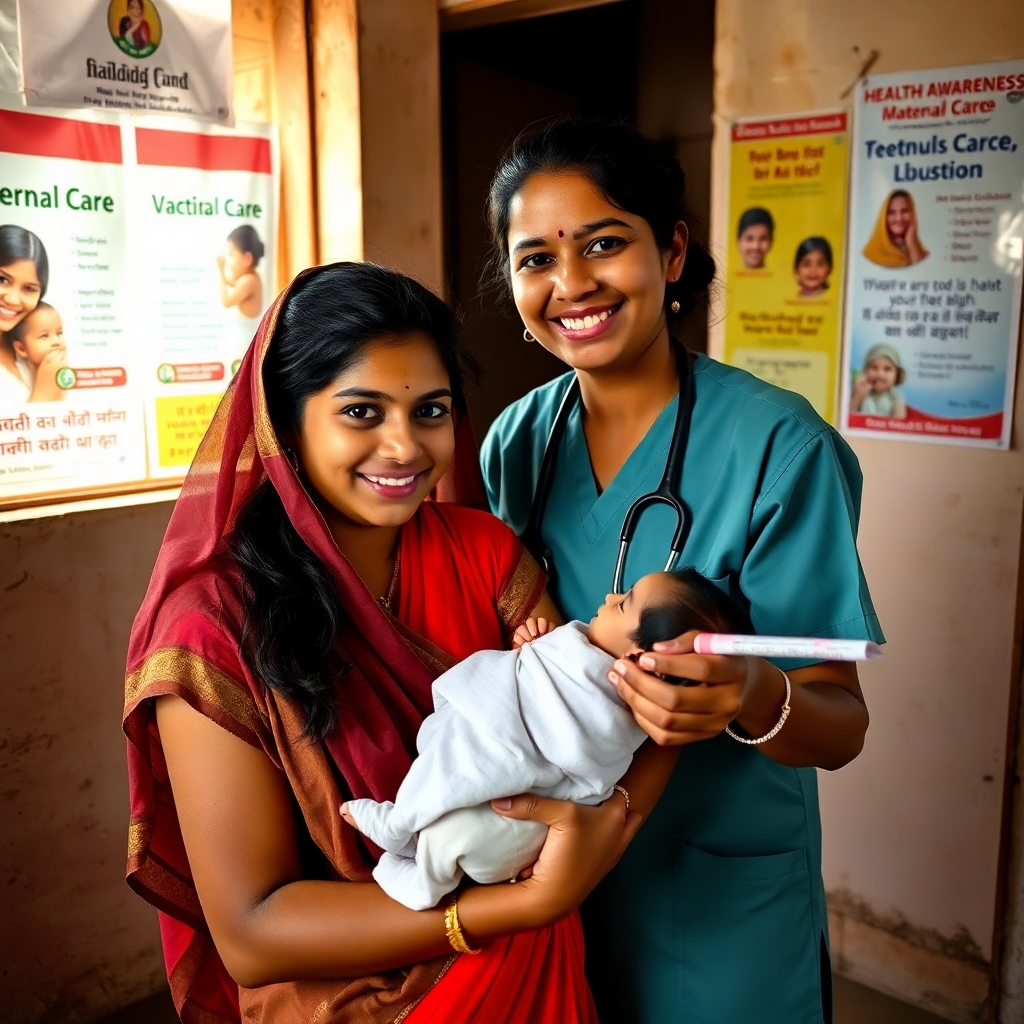
Behind every health milestone, there’s a woman—often several. Not just the mothers and daughters, but the 10 lakh ASHA workers across India. Women like Geeta, who walk miles every day to knock on doors, answer questions, soothe fears, and remind families that their health matters.
These women aren’t just workers—they’re the backbone of rural health. And they’re inspiring change.
In Maharashtra, the “Aarogya Sathi” initiative has trained adolescent girls in reproductive health and hygiene. One of them, 16-year-old Pooja, now teaches younger girls about menstrual health. She says: “No one told us this when we were younger. Now, we want to break that silence.”
The Data Behind the Hope
According to NFHS-6 (2024) the numbers are finally beginning to reflect the effort:
- Maternal Mortality Ratio (MMR) dropped from 130 (in 2016) to 97 per 100,000 live births in 2024.
- Institutional deliveries are now at 94%, up from just 47% in 2005.
- Infant Mortality Rate (IMR) is down to 25 per 1,000 live births.
Still, for every mother and baby that makes it safely, there’s someone in a remote tribal village or dense urban slum who might not.
That’s where innovation comes in.
Health Innovations in India: Merging Tech with Compassion
India is blending tech and tradition to create smarter, more responsive healthcare systems.
- eSanjeevani, a free telemedicine platform, has connected rural patients to city doctors—over 20 crore consultations so far.
- In Meghalaya, drones now deliver vaccines to hilly terrain, cutting down delivery time from days to hours.
- In Rajasthan, Mobile Medical Units bring labs, sonography machines, and ECGs to villages.
“I never thought I’d see a doctor on a video screen,” laughs Kamla, a 60-year-old woman from Jharkhand. “But now I can talk to a heart specialist from Ranchi without leaving my village.”
India’s Global Role in Public Health
India’s efforts are aligned with WHO’s Global Strategy for Women’s, Children’s and Adolescents’ Health, which promotes:
- Survival: Ending preventable deaths
- Thrive: Ensuring health and well-being
- Transform: Creating enabling environments
At the 2023 G20 Health Ministers’ Meeting in Gandhinagar, India showcased its commitment to Universal Health Coverage (UHC) and the power of digital health infrastructure.
“Our vision is a healthier world, starting with a healthier India,” said the Health Minister, emphasizing India’s role in shaping global health dialogues.
What You Can Do on World Health Day
So, what can we do—those of us not running a clinic or designing health policy? Plenty.
- Talk to the women in your life. Ask how their health is.
- Encourage prenatal checkups, regular vaccines, and healthy eating.
- Support local health workers. A kind word or a glass of water goes a long way.
- Speak up about health myths, especially around childbirth and menstruation.
- Vote with your values—support leaders and initiatives that prioritize health equity.
Because health isn’t just a government’s job. It’s all of ours.
In Conclusion: Let’s Live the Pledge
World Health Day isn’t just about systems and stats. It’s about Sunita, who delivered safely. Ravi, who fought TB. Pooja, who’s teaching girls to take control of their health. Geeta, who walks miles every day because she believes health is a human right.
This year, let’s not just observe World Health Day. Let’s live it. Let’s carry forward the theme—“Healthy Beginnings, Hopeful Futures”—not as an idea, but as a promise.
A promise to build a future where every child is born into safety, every mother feels supported, and every person, no matter where they live, can hope for a healthier tomorrow.
References
- WHO. (2023). Maternal Mortality
- UNICEF. (2023). Child Mortality Report
- National Health Authority. (2025). Ayushman Bharat
- Ministry of Health and Family Welfare. (2025). PMSMA Updates
- The Hindu. (2025). TB Elimination in Bihar
- NITI Aayog. (2025). Health Innovations
- National Family Health Survey-6. (2024). NFHS Dashboard
About The Author


