
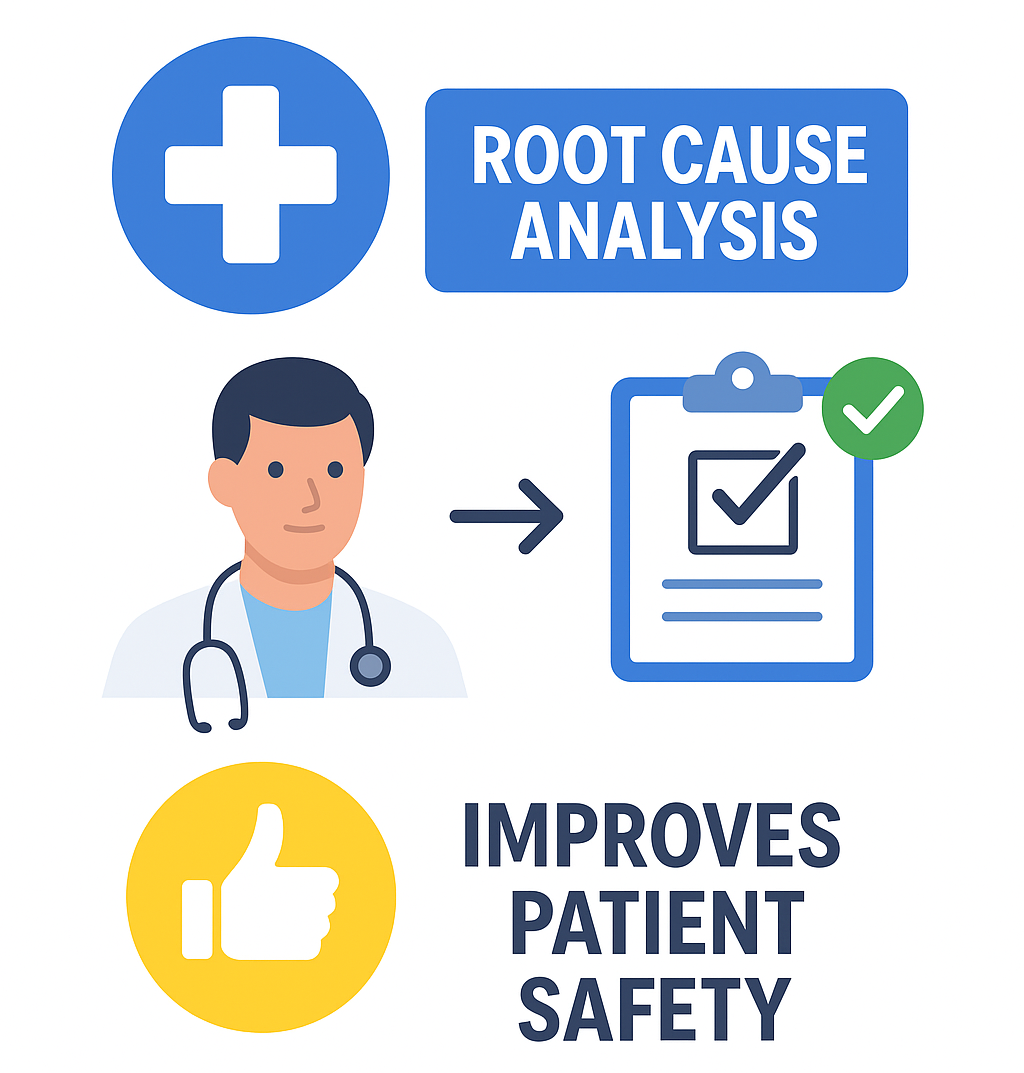
In healthcare, mistakes are not just numbers; they are lived realities that affect patients, families, and care providers. Behind every medication error, delayed diagnosis, or post-surgical complication lies a story. Root Cause Analysis (RCA) is a structured approach that helps us unpack these stories, not with the intention of assigning blame, but to learn from and prevent future harm.
Unlike quick fixes, RCA digs beneath the surface. Instead of stopping at “the nurse forgot” or “the doctor misread,” it asks why the system allowed such an error to occur. Was the medication label confusing? Did the electronic system create alert fatigue? Was the team culture discouraging open communication? By shifting the lens from individuals to systems, RCA brings out the human side of healthcare quality improvement.
The Value of RCA in Healthcare.
One of the most potent aspects of RCA is its ability to transform adverse events into opportunities for systemic improvement. In hospitals, where multiple departments, technologies, and human factors intersect, errors are rarely caused by the negligence of any single person. RCA reveals the “hidden cracks” in workflows and processes. For example, a wrong-patient blood transfusion might trace back to poorly designed ID bands, inadequate double-check protocols, and a culture where staff feel pressured to rush. Fixing these root issues leads to safer, more reliable care.
RCA is critical in today’s healthcare environment, where quality accreditation standards, such as NABH and JCI, expect hospitals not only to record adverse events but also to demonstrate structured learning from them. Beyond compliance, RCA fosters a safety culture where staff feel secure in reporting mistakes and leaders view every incident as an opportunity to improve. This shift from punishment to problem-solving is what differentiates world-class hospitals from those stuck in cycles of repeated failures.
How RCA Works.
A multidisciplinary team usually conducts the process and involves:
- Data collection – reviewing records, interviewing staff, and reconstructing the event.
- Analysis tools – using Fishbone (Ishikawa) diagrams, the “Five Whys” method, or Pareto analysis to identify causes.
- Identifying systemic gaps – communication failures, workflow design issues, or resource limitations.
- Action planning – developing corrective measures that are specific, measurable, and sustainable.
While this sounds structured, at its heart, RCA is a human exercise in empathy and systems thinking. It brings together doctors, nurses, administrators, and even patients to understand not only what went wrong, but also how future patients can be better protected.
Real-World Illustrations.
Consider a case from the United States where a young patient nearly died after receiving 39 times the intended antibiotic dosage. The RCA revealed a mix of design flaws in the electronic prescribing system, excessive alert fatigue, and a hierarchical culture where nurses hesitated to challenge orders. The solution wasn’t simply to “train better” but to redesign interfaces, reduce unnecessary alerts, and empower staff to speak up.
Closer to home, in Indian outpatient clinics, RCA has been used to understand why patients felt dissatisfied. It was not always the clinical care that bothered them, but rather issues such as a lack of lab services, long waiting times, and unclear communication. By addressing these systemic gaps, hospitals not only improved safety but also patient satisfaction, a reminder that quality is as much about trust as it is about outcomes.
Why Hospitals Struggle With RCA.
Despite its importance, RCA often fails to reach its potential. Many hospitals stop at superficial fixes like “conduct more training” or “remind staff to be careful,” which rarely address systemic flaws. Others treat RCA as a compliance checkbox for accreditation rather than a meaningful exercise. The emotional weight of investigating errors, resource limitations, and lack of leadership buy-in also weakens implementation.
To make RCA effective, hospitals must treat it as a strategic investment in culture and quality. Leadership commitment, staff training in safety science, and the creation of non-punitive reporting systems are essential. Equally important is ensuring that recommendations are actually implemented and their effectiveness is measured.
The Way Forward.
In an era where patients are increasingly aware, regulators are more demanding, and competition among hospitals is fierce, RCA is no longer optional; it is essential. Hospitals that adopt it move closer to becoming “learning organizations,” where every adverse event serves as a stepping stone to safer care.
Technology will also play a role. Simulation-based RCA training, AI-assisted error tracking, and predictive analytics will soon make root cause analysis faster and more insightful. But at its core, RCA will always remain a human process, a collective effort to ensure that behind every error lies a lesson, not a repeated tragedy.
Key Takeaways.
- RCA looks beyond blame, focusing on systemic causes rather than individual mistakes.
- It fosters a culture of quality: Encourages open reporting and continuous improvement.
- Real impact comes from action: Solutions must be systemic, measurable, and implemented.
- It protects patients and staff alike: Safer systems reduce harm and build trust.
References.
- AHRQ Patient Safety Network. Root Cause Analysis Primer.
- Wu AW, Lipshutz AK, Pronovost PJ. Effectiveness and Limitations of RCA in Healthcare. JAMA. 2008.
- Vincent C. Patient Safety. Wiley-Blackwell, 2010.
- Reason J. Human Error. Cambridge University Press, 1990.
- JCI & NABH Standards for Hospitals – Quality & Patient Safety Requirements.
About The Author


