

When I first rolled out my yoga mat, I thought yoga was about touching my toes. I practiced asanas with the enthusiasm, believing that if I could hold Headstand for thirty seconds, I’d “done yoga.” What I didn’t understand then was what so many of us still miss today is that the physical postures are merely the doorway, not the destination.
This International Yoga Day 2026, as we celebrate this 5,000 year old Indian practice globally with a theme of “Yoga for Healthy Ageing” focusing on holistic health, physical vitality and mental clarity across all stages of life, I want to share something that transformed my understanding. According to Maharshi Patanjali’s ancient Yoga Sutras, meditation (Dhyana) and Pranayama (conscious breath control) are not optional additions to yoga rather they are its very essence.
The Misconception That Won’t Die.
Let’s be honest, modern yoga has become “performative”. We post asana photos on Instagram, compete in yoga challenges and measure our progress by how deep our forward bend goes. The United Nations itself recognized yoga’s universal appeal when the member states co sponsored India’s resolution for International Yoga Day in 2014, first celebrated in 2015. But somewhere in this global wellness movement, we have forgotten what yoga actually means.
Maharshi Patanjali, in the second yoga sutra, gives us yoga’s true definition: “Yogaś citta vṛtti nirodhaḥ”. Yoga is the cessation of the fluctuations of the mind. Not the flexibility of your hamstrings. Not the angle of your pelvic tilt. The stillness of your consciousness. If your mind is racing during (Veer Bhadrasana II) Warrior II, you are not doing yoga, even if your form is perfect.
Maharshi Patanjali’s Eight Limbed Path: Where Asana Actually Fits.
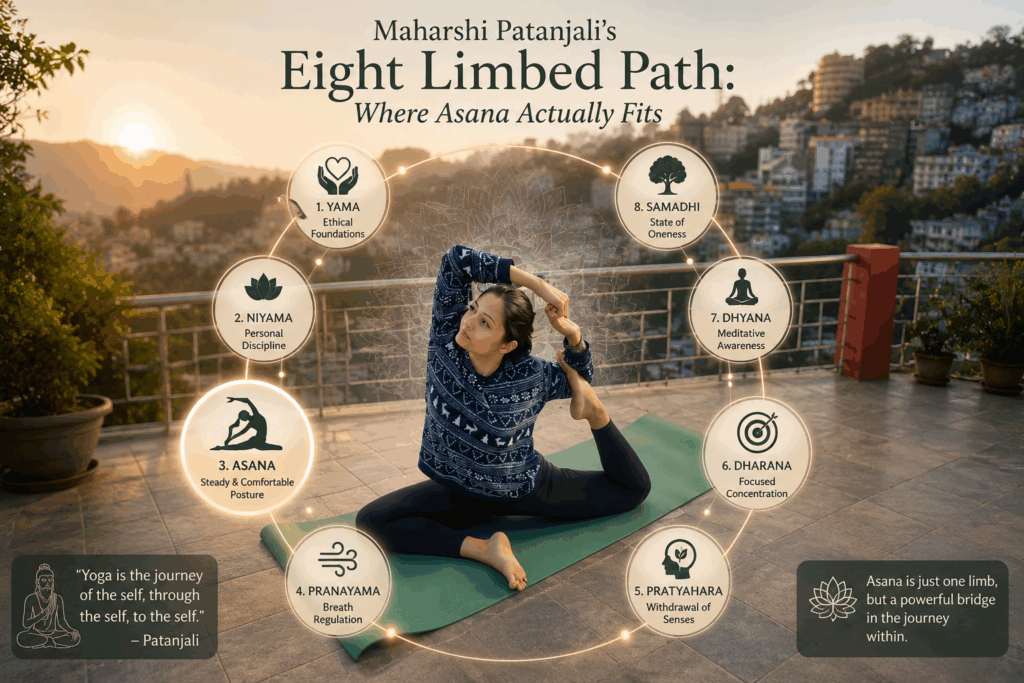
Patanjali’s Yoga Sutras outline eight limbs (Ashtanga Yoga) that form a progressive path:
- Yama (ethical restraints)
- Niyama (observances)
- Asana (physical postures)
- Pranayama (breath control)
- Pratyahara (sense withdrawal)
- Dharana (concentration)
- Dhyana (meditation)
- Samadhi (enlightenment)
Noticed something? Asana is the third limb. Pranayama is the fourth. Meditation (Dhyana) is the seventh. If we’re building a house, Asana is the foundation; it is necessary, but not the roof where you actually live.
The sad truth is that most modern practitioners stop at limb three. We have commercialized this one the most and called it “yoga.”
Pranayama: The Bridge Between Body and Mind.
In Yoga Sutra 2.49, Patanjali defines Pranayama: “Tasmin sati śvāsa praśvāsayo gati vighātaḥ pranāyāmaḥ” After mastering Asana, the regulation of inhalation (poorak), exhalation (rechak) and retention (kumbhak) is Pranayama.
Patanjali doesn’t just mean “breathing exercises.” In sutras 2.50–52, he explains that Pranayama has three dimensions, external (expiration), internal (inhalation), and suspended (retention Aantar and Bahir kumbhak) and when practiced correctly, it dissolves the covering that blocks our inner light.
The breath is the only physiological process we can control consciously while also being automatic. This makes it the perfect bridge between the body and mind. When you slow your breath, your mind slows. When your mind becomes anxious, your breath becomes shallow. Pranayama is the master key that unlocks this connection.
I remember the first time I practiced Anulom Vilom (alternate nostril breathing) for twenty minutes without stopping. My sitting posture didn’t change. My muscles weren’t engaged. But something profound shifted inside. The constant chatter in my mind, the “what about this, what about that”, calmed down. That’s not relaxation. That’s yoga.
Meditation: The Seventh Limb That Completes the Journey.
If Pranayama is the bridge, meditation (Dhyana) is the destination Patanjali is pointing toward. In Sutra 3.2, he describes Dhyana as “tatra pratyayāikāntatā dhyānaḥ” when the mind becomes fixed on one point without interruption, that is meditation.
Think about what this means. Asana prepares the body to sit without discomfort. Pranayama calms the nervous system and purifies the mind. But without meditation, you are still just exercising. You haven’t touched the core purpose of yoga, to stop the mind’s endless fluctuations.The soul is nurtured through meditation, not through perfecting your arm balance.
Why Meditation and Pranayama Are More Important Than Asana.
Let me state directly, if you are practicing yoga for spiritual growth, mental clarity or self realization, then meditation and Pranayama are objectively more important than asanas. Here’s why:
- Proximity to the Goal
Asana is 3rd limb. Meditation is limb 7th. The goal of yoga (Samadhi) is limb 8th. You get closer to the goal with each limb. Meditation is one step away. Asana is five steps away.
- Direct Impact on the Mind
Asana affects the body primarily. Pranayama affects both body and mind. Meditation affects the mind directly. Since yoga’s definition is about stopping mental fluctuations, the practice that most directly impacts the mind is most aligned with yoga’s purpose.
- Sustainability
You can practice meditation and Pranayama at any age, with any physical condition, anywhere in the world. Asana becomes increasingly difficult as we age or face physical limitations. But the breath? The mind’s capacity for stillness? Those remain accessible forever.
- Maharshi Patanjali’s Own Emphasis
Read the Yoga Sutras. Patanjali spends far more verses on Pranayama and meditation than on asana. Sutra 2.49–55 covers Pranayama in detail. Sutra 3.1–9 covers meditation techniques extensively. Asana? Sutra 2.46–48. Three sutras. The math speaks for itself. That’s why Meditation and Pranayama deserve equal billing with Asana”.
A Personal Revelation.
I will share something that changed everything for me. Last year, I tried a 30 day challenge, I reduced my asana practice from 60 minutes to 20 minutes and doubled my meditation and Pranayama time, because I was hard pressed with time and there was a lot going on in my mind. I didn’t want to miss yoga too. However, practising this I felt more centered, more clear, more yoga. My asana practice did not stop. But my mind? My mind was quiet. The constant anxiety about “what ifs and next” diminished. I slept better. I responded to stress instead of reacting. I noticed beauty I’d been missing.
What This Means for International Yoga Day 2026, 21st June.
This year’s theme, “Yoga for Healthy Ageing” emphasis more upon yoga is not only for young people, but it is equally beneficial for older adults as well. In fact, yoga helps people age gracefully with strength, balance and mental peace. Yoga for healthy aging also teaches us that taking care of our body is important at every stage of life. Whether you are young or old, yoga supports long term health, happiness and more peaceful life. The answer isn’t in doing more poses. It’s in returning to the practices that calm the mind and deepen awareness with pranayama and meditation.
Here’s my suggestion for practising a simple balanced routine:
- 20 minutes Asana (honor the body)
- 20 minutes Pranayama (honor the breath)
- 20 minutes Meditation (honor the mind)
This International Yoga Day, let’s celebrate yoga authentically. Let’s honor Maharshi Patanjali’s wisdom by practicing what he actually taught. Let’s stop measuring yoga by how deep our forward bend is and start measuring it by how quiet our mind becomes.
The pose is temporary. The peace is eternal.
May your breath be conscious, your mind be still and your yoga be authentic.
About The Author


