
Table of Contents
Introduction
India’s healthcare sector is undergoing a revolution, driven by expanding health insurance coverage and government-backed schemes. However, despite these efforts, 40.5% of Indians remain uninsured, leading to high out-of-pocket medical expenses and limited access to quality healthcare.
The rise of Ayushman Bharat – Pradhan Mantri Jan Arogya Yojana (AB-PMJAY) and other insurance programs is reshaping India’s public health landscape. This article explores how insurance is improving healthcare access, reducing medical costs, and what the future holds for health insurance in India.
Current Health Insurance Coverage in India.
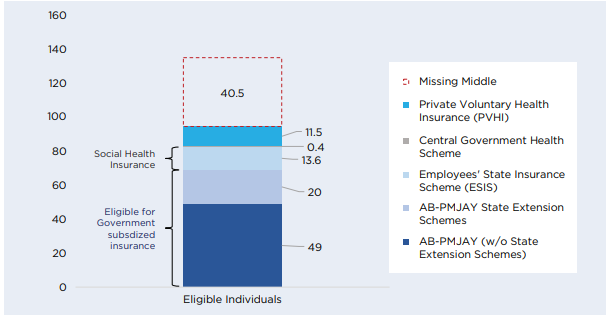
Understanding the distribution of health insurance coverage in India is crucial for addressing gaps in access. Here’s how the population is covered:
- 49% covered under AB-PMJAY (the government’s flagship health insurance scheme).
- 20% covered under state-sponsored AB-PMJAY extensions.
- 13.6% covered under ESIS (Employees’ State Insurance Scheme for formal-sector workers).
- 0.4% covered under CGHS (Central Government Health Scheme for government employees).
- 11.5% have private voluntary health insurance.
- 40.5% of the population remains uninsured.
This large uninsured segment remains vulnerable to catastrophic health expenditures, which push millions into poverty each year.
6 Ways Health Insurance Is Changing Public Healthcare in India
Expanding Healthcare Access
With 69% of India’s population covered under government health insurance schemes, more people can access affordable hospital treatments and cashless medical services, especially in rural areas.
Lowering Out-of-Pocket Healthcare Costs
India has one of the highest out-of-pocket healthcare expenditures globally. Expanding AB-PMJAY and ESIS coverage helps families avoid financial distress due to medical emergencies.
Boosting Public Healthcare Infrastructure
As insurance adoption increases, the demand for hospitals, diagnostic centers, and primary healthcare facilities is rising, leading to:
- More government investments in medical infrastructure.
- Increased employment in the healthcare sector.
- Reduced pressure on overburdened government hospitals.
Promoting Preventive Healthcare & Early Diagnosis
Government insurance schemes increasingly cover preventive screenings for diabetes, hypertension, and cancer, ensuring early detection and better health outcomes.
Growth of Private Health Insurance & Hybrid Models
While only 11.5% of Indians have private insurance, this sector is set to grow, offering:
- Higher coverage limits
- Faster medical care
- Better specialist access
A hybrid model, combining public insurance with private healthcare facilities, could improve efficiency and accessibility.
Addressing the 40.5% Uninsured Population
Despite progress, over 500 million Indians remain uninsured. Expanding public awareness campaigns, simplifying insurance enrollment, and introducing affordable private plans will be key to achieving universal health coverage (UHC).
Challenges in Expanding Health Insurance Coverage
| Challenge | Solution |
| High out-of-pocket medical expenses | Expand insurance to cover OPD services, diagnostics, and medicines. |
| Low awareness of government schemes | Nationwide digital awareness campaigns & health literacy programs. |
| Public hospital overcrowding | Public-private partnerships to expand healthcare access. |
| Insurance fraud & misuse | AI-based fraud detection & claims verification systems. |
Future of Health Insurance in India
As India moves toward universal health coverage, the future will be driven by:
- Telemedicine & Digital Health Innovations – AI-driven healthcare, digital claims processing, and online consultations will make healthcare more accessible.
- Expansion of AB-PMJAY Coverage – Including maternity care, mental health services, and outpatient treatments.
- Affordable Private Insurance Models – Customized insurance plans for middle-income groups to fill coverage gaps.
- Focus on Preventive Healthcare – Government and private insurers will emphasize wellness programs and preventive screenings.
Conclusion
Health insurance is revolutionizing India’s healthcare system. With 69% of the population covered under government-backed schemes, medical care is becoming more affordable and accessible. However, achieving 100% health coverage will require policy improvements, enhanced infrastructure, and public awareness initiatives.
As health insurance adoption increases, India is set to witness a major transformation in public healthcare, reducing financial hardships and improving medical outcomes for millions.
Further Reading
- Ayushman Bharat, a flagship scheme of Government of India, was launched as recommended by the National Health Policy 2017, to achieve the vision of Universal Health Coverage (UHC).
- HEALTH INSURANCE / ASSURANCE IN INDIA: NEED AND LANDSCAPE
- Public Health Insurance Status and Utilization of Healthcare Services Across India: A Narrative Review
About The Author


