

Table of Contents
As India’s population ages at an unprecedented pace, the Longitudinal Ageing Study in India (LASI) offers a powerful roadmap for building resilient healthcare systems, evidence-based public policies, and a healthier future for millions.
India Is Growing Older Much Faster Than We Think
For decades, India’s demographic story has revolved around one defining advantage: its youthful population. A large working-age workforce has powered economic growth, accelerated urbanization, and positioned the country as one of the world’s fastest-growing economies. Yet beneath this familiar narrative, another profound transformation is quietly unfolding India is ageing, and it is ageing faster than most people realise.
Unlike sudden public health crises, population ageing is a gradual transition. It rarely captures headlines, yet it has the potential to reshape healthcare systems, social structures, labour markets, public finances, and family dynamics more profoundly than almost any other demographic change. Longer life expectancy, declining fertility rates, improved disease control, and better living standards have collectively altered India’s population profile, creating both extraordinary opportunities and unprecedented challenges.
This transformation should not be viewed simply as an increase in the number of older adults. Rather, it represents a shift in how societies must think about health itself. The healthcare systems of tomorrow will no longer be judged solely by their ability to treat disease; they will increasingly be measured by how effectively they enable people to age with dignity, independence, and good quality of life.
Recognising this need, the Longitudinal Ageing Study in India (LASI) has emerged as one of the country’s most significant public health research initiatives. By systematically examining the health, economic, psychological, and social dimensions of ageing, LASI provides an evidence-based foundation for understanding one of the most important demographic transitions of the twenty-first century.
Ageing Is a Global Success Story-And a Global Challenge.
Population ageing is often described as one of humanity’s greatest achievements. Advances in medicine, vaccination, sanitation, nutrition, education, and public health have dramatically increased life expectancy across the world. People today are living longer than at any other point in history.
According to the LASI report, global life expectancy has risen steadily over the past seven decades, while fertility rates have declined significantly. As a result, the proportion of older adults is increasing rapidly across both developed and developing nations. By 2050, people aged 65 years and above are projected to outnumber children under the age of fifteen globally, fundamentally altering demographic structures worldwide.
However, longevity brings with it a new set of questions. How do healthcare systems manage rising rates of chronic diseases? How should governments finance long-term care? Who will support an ageing population in societies where traditional family structures are changing? How can countries ensure that longer lives remain healthy, productive, and socially connected?
These questions are becoming increasingly relevant for India.
India’s Demographic Transition: From Young Nation to Ageing Society.
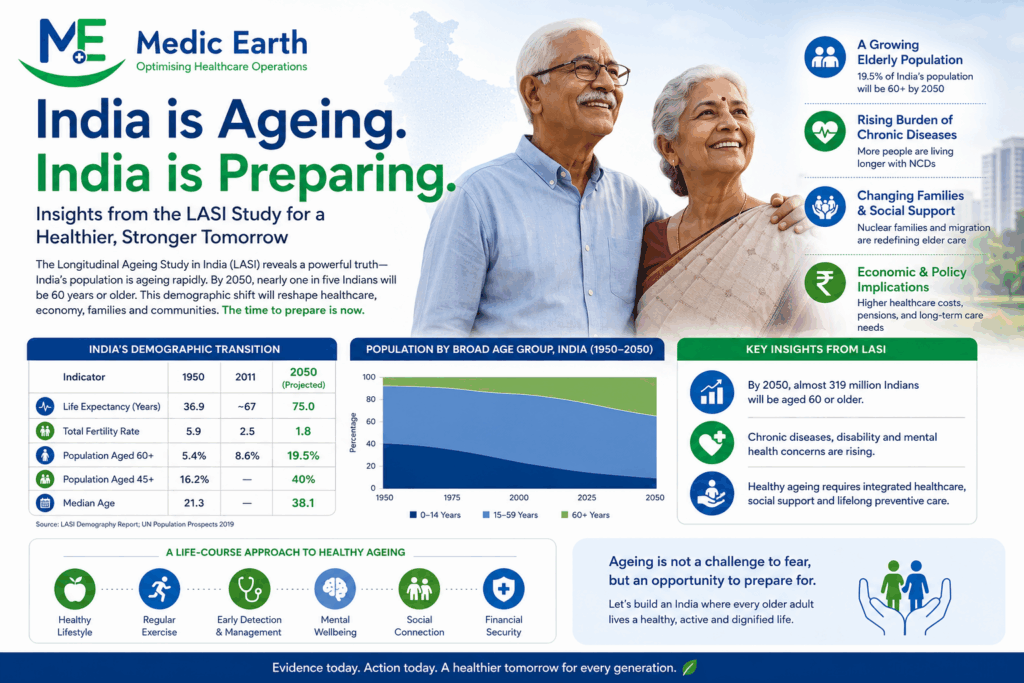
India’s demographic transition is unfolding at remarkable speed. While the country continues to enjoy a relatively young population compared with many developed nations, demographic indicators clearly show that the age structure is changing.
The LASI report highlights that people aged 60 years and above accounted for approximately 8.6% of India’s population in 2011, representing nearly 103 million older adults. By 2050, this proportion is projected to rise to 19.5%, equivalent to nearly 319 million elderly citizens-almost three times the current population of many countries. At the same time, individuals aged 45 years and above are expected to constitute nearly 40% of India’s total population, underscoring the growing importance of healthy ageing across the life course.
This demographic shift is driven by two powerful forces working simultaneously: increasing life expectancy and declining fertility. India, where an individual born in 1950 could expect to live for only about 37 years, is projected to see average life expectancy rise to nearly 75 years by 2050. Meanwhile, the total fertility rate has declined dramatically from approximately 5.9 children per woman in the 1950s to near replacement levels today, and is expected to continue falling.
These changes are steadily transforming India’s population pyramid into a more balanced age structure, reducing the proportion of children while expanding both the working-age and elderly populations.
India’s Demographic Transition
| Indicator | 1950 | 2025 | 2050 |
| Life Expectancy | 36.9 years | 71.4 years | 75.3 years |
| Total Fertility Rate | 5.9 | 2.1 | 1.8 |
| Population aged 60+ | 5.4% | 11.4% | 19.5% |
| Population aged 75+ | 0.9% | 2.3% | 5.2% |
| Median Age | 21 years | 30 years | 38 years |
Source: LASI Demography Report.
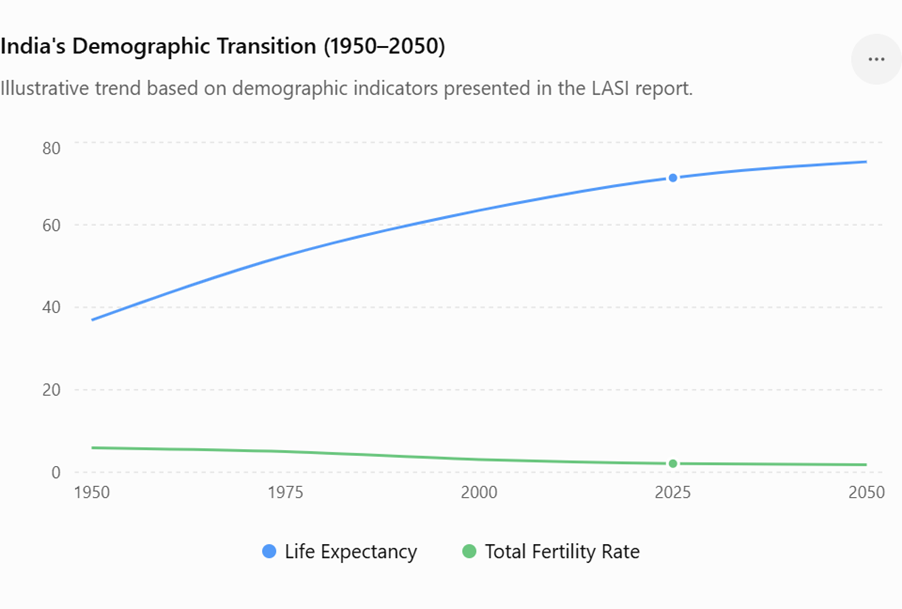
These figures illustrate far more than demographic evolution-they signal a transformation in healthcare demand. As the proportion of older adults grows, hospitals, policymakers, insurers, and communities will need to prepare for a future where chronic disease management, rehabilitation, preventive care, and long-term support become central pillars of healthcare delivery.
Why the LASI Study Matters.
For years, discussions about ageing in India were constrained by fragmented datasets and cross-sectional surveys that provided only a limited understanding of older adults’ lives. LASI was conceived to address this critical evidence gap.
Modelled on internationally recognised Health and Retirement Studies conducted across more than forty countries, LASI is India’s first nationally representative longitudinal ageing study. It follows adults aged 45 years and above over time, allowing researchers to understand not only how people age, but also how health, financial security, social participation, family structures, and healthcare utilisation evolve throughout later life.
The scale of the study is unprecedented. Covering all states and union territories, the first wave includes more than 72,000 adults aged 45 years and above, making it one of the largest ageing studies anywhere in the world. Unlike traditional surveys that focus only on disease prevalence, LASI integrates biological measurements, physical assessments, mental health indicators, social wellbeing, healthcare access, employment, retirement, financial security, and family support into a single nationally harmonised dataset.
This multidisciplinary approach reflects an important shift in thinking. Healthy ageing cannot be understood solely through medical diagnoses. It is equally influenced by education, income, employment, housing, nutrition, social engagement, psychological wellbeing, and access to healthcare services. By examining these dimensions together, LASI enables policymakers and healthcare leaders to move beyond reactive disease management towards evidence-based planning that supports healthy ageing throughout the life course.
In many ways, LASI is more than a research study-it is a blueprint for understanding how demographic change will influence India’s healthcare priorities over the coming decades.
The Changing Face of Disease: Living Longer, Living with More Chronic Conditions.
One of the most significant findings emerging from the LASI study is that India’s health profile is undergoing a fundamental transformation. A few decades ago, infectious diseases, maternal health conditions, and nutritional deficiencies dominated the country’s public health agenda. Today, improvements in sanitation, vaccination, and healthcare have dramatically reduced many of these challenges. However, increased longevity has brought with it a different set of health concerns.
As people live longer, they are increasingly affected by chronic non-communicable diseases (NCDs) that require continuous care rather than one-time treatment. Conditions such as hypertension, diabetes, cardiovascular disease, chronic respiratory illnesses, stroke, arthritis, osteoporosis, chronic kidney disease, dementia, depression, and cancers have become increasingly common among older adults. The LASI study highlights that many elderly individuals are not living with a single disease but with multiple chronic conditions simultaneously, a phenomenon known as multimorbidity.
This shift has profound implications for healthcare delivery. Managing a patient with diabetes, hypertension, kidney disease, and arthritis requires coordinated care involving physicians, dietitians, physiotherapists, pharmacists, mental health professionals, and rehabilitation specialists. Healthcare systems designed primarily to treat acute illnesses must therefore evolve into integrated models capable of supporting lifelong disease management.
Ageing in India Is Not Uniform.
One of the strengths of the LASI study is that it demonstrates how ageing varies considerably across different regions of the country. India’s demographic transition is not occurring at the same pace everywhere. States that have experienced lower fertility rates, higher literacy levels, and better health indicators over several decades now have a substantially older population than states where fertility remains relatively high.
Southern states such as Kerala and Tamil Nadu are among the most advanced in demographic ageing, reflecting improvements in education, healthcare access, and life expectancy. In contrast, several northern and central states continue to have younger population structures because of comparatively higher fertility rates.
These regional differences have important policy implications. Healthcare planning cannot follow a one-size-fits-all approach. States with rapidly ageing populations require greater investment in geriatric medicine, rehabilitation, long-term care facilities, dementia services, palliative care, and home healthcare, while younger states must continue balancing maternal and child health priorities alongside preparations for future ageing.
Healthcare policies, therefore, must remain flexible, evidence-based, and responsive to local demographic realities.
Beyond Healthcare: The Social Dimensions of Ageing.
Ageing is often discussed from a medical perspective, but the LASI study reminds us that growing older is equally a social experience. Physical health is closely intertwined with emotional wellbeing, family support, financial security, housing, and community participation.
Traditionally, Indian families have provided care for older adults through strong intergenerational support systems. However, rapid urbanisation, migration, changing employment patterns, and the rise of nuclear families are gradually transforming these social structures. Many elderly individuals now live independently or with only their spouse, while younger family members relocate to other cities or countries for education and employment.
This changing social landscape introduces new challenges, including loneliness, reduced social engagement, financial dependence, and limited access to caregivers. These factors can significantly influence both physical and mental health.
The concept of healthy ageing therefore extends well beyond disease prevention. It encompasses the ability to remain socially connected, emotionally resilient, financially secure, and actively engaged within one’s community.
The Economic Impact of an Ageing Population.
Population ageing is frequently perceived as a healthcare issue, but its implications extend deeply into national economies.
As the proportion of older adults increases, countries experience higher healthcare expenditure, greater demand for long-term care services, increased pension obligations, and changing workforce dynamics. At the same time, declining fertility means fewer working-age individuals are available to support a growing elderly population.
However, ageing should not be viewed solely as an economic burden. It also presents significant opportunities.
The expanding “silver economy,” comprising products and services designed for older adults,is emerging as one of the fastest-growing sectors globally. Demand for preventive healthcare, digital health technologies, rehabilitation, home-based medical care, assisted living facilities, medical devices, age-friendly housing, health insurance, wellness programmes, and telemedicine is expected to grow substantially over the coming decades.
Healthcare organisations that invest early in age-friendly services will be well positioned to meet these changing needs.
Healthcare Priorities in an Ageing India
| Traditional Healthcare Model | Future Age-Friendly Healthcare Model |
| Treatment-focused | Prevention and healthy ageing |
| Episodic care | Continuous care management |
| Hospital-based services | Community and home-based care |
| Single-specialty treatment | Multidisciplinary integrated care |
| Disease-centred | Person-centred care |
| Reactive interventions | Predictive and preventive healthcare |
From Disease Management to Healthy Ageing.
One of the most important messages emerging from the LASI study is that longevity alone should not be considered the ultimate measure of healthcare success. Living longer is meaningful only when those additional years are lived with independence, dignity, and good quality of life.
This philosophy aligns closely with the World Health Organization’s concept of Healthy Ageing, which emphasizes maintaining functional ability rather than simply preventing disease.
Healthy ageing begins much earlier than retirement. It is shaped by lifelong behaviours, including balanced nutrition, regular physical activity, preventive health screenings, adequate sleep, vaccination, mental wellbeing, cognitive stimulation, and social engagement. Early diagnosis and effective management of chronic conditions further contribute to preserving functional capacity in later life.
Hospitals and healthcare providers therefore have a critical role in shifting public attention from illness treatment to lifelong health promotion.
How Future Hospitals Must Transform.
As India’s elderly population continues to grow, hospitals will increasingly become centres for integrated ageing care rather than facilities focused solely on acute illness.
Future-ready healthcare institutions will need to strengthen services such as geriatric medicine, comprehensive chronic disease clinics, memory assessment centres, stroke rehabilitation, falls prevention programmes, palliative care, home healthcare, preventive health check-ups, and multidisciplinary rehabilitation. Digital technologies—including artificial intelligence, remote patient monitoring, wearable health devices, electronic health records, and telemedicine—will play an equally important role in supporting continuity of care beyond hospital walls.
The hospitals that adapt to these changing demographic realities today will be better prepared to deliver high-quality, patient-centred care tomorrow.
A Roadmap for Policymakers.
The LASI study provides policymakers with one of the most comprehensive evidence bases available for planning India’s future health and social care systems. It highlights the need for stronger primary healthcare, expanded geriatric services, greater emphasis on preventive medicine, improved mental healthcare, age-friendly public infrastructure, and enhanced financial protection for older adults.
Government initiatives such as the National Programme for Health Care of the Elderly (NPHCE), Ayushman Bharat, Health and Wellness Centres, and other social protection programmes represent important steps towards preparing the country for demographic ageing. However, sustained investment in healthcare infrastructure, workforce training, digital innovation, and community-based care will be essential to meet future demands.
Looking Ahead: An Opportunity to Redefine Healthcare.
India’s demographic transition represents one of the defining public health stories of the twenty-first century. The country’s ageing population should not be viewed as a looming crisis but as an opportunity to reimagine healthcare around prevention, resilience, and lifelong wellbeing.
The LASI study clearly demonstrates that healthy ageing is influenced by much more than medicine alone. Education, nutrition, employment, financial security, social participation, environmental conditions, and equitable access to healthcare all contribute to how individuals experience later life. Building systems that integrate these dimensions will be essential for ensuring that increased longevity translates into improved quality of life.
Rather than asking how India will care for a growing elderly population, the more important question is how the nation can enable millions of people to remain healthy, active, and independent for as long as possible.
Conclusion.
The Longitudinal Ageing Study in India (LASI) marks a watershed moment in understanding one of the country’s most significant demographic transformations. Its findings make it clear that India’s healthcare priorities must evolve alongside its changing population. As life expectancy rises and the proportion of older adults continues to grow, healthcare systems must transition from episodic treatment to preventive, integrated, and person-centred models of care.
Preparing for an ageing India requires more than expanding hospital capacity. It calls for investment in healthy ageing, stronger primary care, multidisciplinary clinical services, rehabilitation, mental health support, digital health, and community-based care. Most importantly, it requires a shift in mindset—from adding years to life to adding life to years.
India’s ageing revolution has already begun. The choices made today by policymakers, healthcare institutions, researchers, and communities will determine whether the nation simply grows older or grows older healthier, stronger, and with greater dignity for generations to come.
About The Author


