

Primary care is where most people first turn when mental-health problems begin, yet traditional workflows often miss opportunities to measure, track, and respond to changes in symptoms between visits. Real-time measurement of mental-health outcomes using brief patient-reported outcome measures (PROMs), app or portal data, and remote monitoring is changing that. When embedded into primary-care workflows, these approaches transform sporadic screening into continuous, actionable information that helps clinicians personalize treatment, spot deterioration early, and close the gap between need and care. Evidence and real-world pilots show that measurement-based care improves outcomes, engagement, and clinical decision making, and the tools to scale it into primary care have finally matured.
What does “real-time” measurement mean in primary care?
“Real-time” does not require constant streaming of biometric data; instead, it means timely, frequent, and actionable patient feedback between encounters. Examples include: weekly PHQ-9 or GAD-7 questionnaires delivered by SMS or app; ecological momentary assessments (short mood check-ins) pushed to smartphones; integration of app-based cognitive-behavioural therapy engagement metrics into the electronic health record (EHR); and alerts from remote platforms when a patient’s scores cross a risk threshold. These inputs let primary-care teams monitor treatment response, detect worsening (including suicidality), and adjust medication or referral promptly, much like measuring blood pressure to guide hypertension therapy.
Why primary care is the right place to implement real-time measurement.
Primary care already manages chronic conditions and coordinates care; adding measurement for mental health builds on existing strengths. Integrated models, notably the Collaborative Care Model and other behavioural health integration efforts, use measurement to track depression and anxiety outcomes and have consistently shown better symptom reduction than usual care. Measurement-based care (MBC) provides objective data that supports brief primary-care interventions, timely referrals, and more efficient use of scarce specialty resources. For health systems, MBC can improve quality metrics and patient satisfaction while enabling population-level monitoring.
Real examples that work.
- NeuroFlow (USA) – A digital platform used in several health systems that delivers brief assessments and aggregates patient engagement and symptom data for primary-care clinicians. In pilots, NeuroFlow flagged worsening symptoms earlier and facilitated timely referrals to behavioral health teams. Its model demonstrates how a simple patient app and clinician dashboard can bridge the communication gap.
- EHR-embedded PHQ-9 workflows – Numerous primary-care clinics have implemented routine PHQ-9 collection at intake and via patient portals. When clinics transitioned from one-time screening to repeated PHQ-9s (measure-and-track), clinicians could identify non-responders more quickly and adjust treatment plans accordingly. Implementation projects led by quality improvement organizations demonstrate improved adherence to treatment guidelines.
- Electronic PROMs in chronic disease clinics – Recent systematic reviews show ePROM systems that collect symptoms and function remotely can be adapted for mental health in primary care; they enable clinicians to view trends and respond between visits, particularly effective for comorbid physical-mental health patients.
Practical steps to implement real-time measurement in primary care.
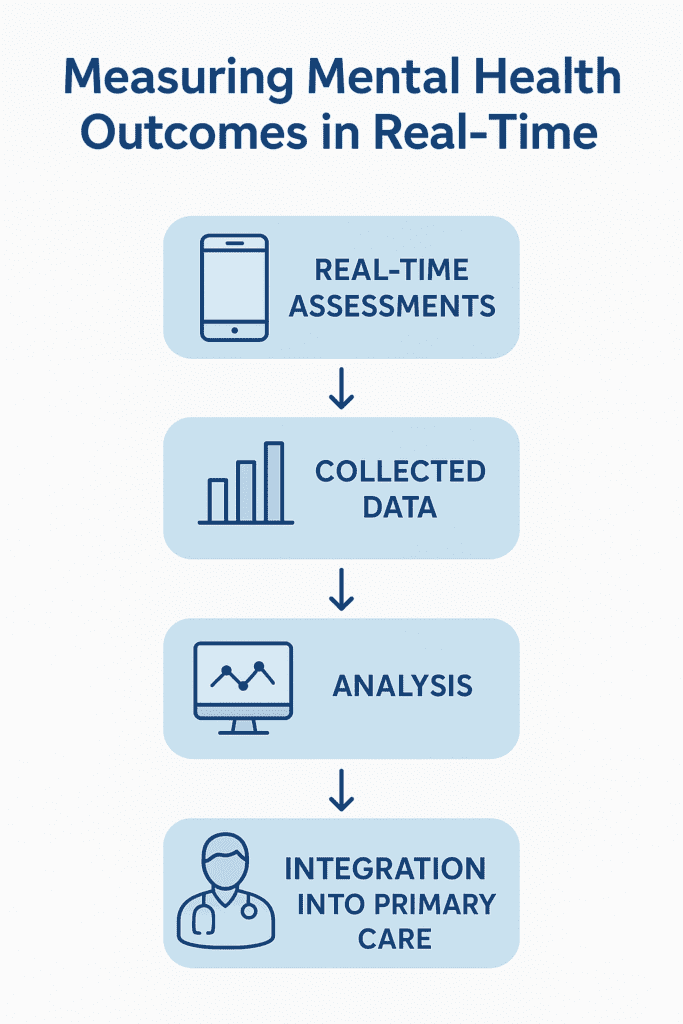
- Choose brief, validated measures. PHQ-2/PHQ-9 and GAD-2/GAD-7 remain workhorses. For routine monitoring, shorter weekly check-ins (single-item mood scales) reduce burden while preserving signal. Use validated tools to preserve comparability and meaning.
- Make collection frictionless. Use SMS, EHR patient portals, or lightweight apps. Push reminders and allow flexible completion windows. The easier it is for patients, the higher the completion rates and the better the longitudinal picture.
- Integrate into clinician workflows. Data should appear in the EHR or a simple dashboard with trendlines and risk flags. Provide one-click suggested actions (e.g., increase visit frequency, adjust meds, urgent referral). Measurement data without a plan to act creates alert fatigue.
- Define thresholds and escalation pathways. Decide in advance what score changes require outreach (e.g., PHQ-9 increase >5 or new suicidality flag). Assign roles: care manager, nurse, or behavioural health specialist to respond. This reduces ambiguity and speeds action.
- Use measurement to personalize care plans. Track outcomes to determine whether psychotherapy, medication, or combined therapy should be continued, adjusted, or referred. Shared decision-making supported by visible trends increases patient engagement.
- Address digital equity and privacy. Offer non-digital options (phone calls, clinic kiosks) for patients without smartphones. Secure consent and be transparent about data use and who sees the results.
Challenges and how to overcome them.
- Clinician time and workflow disruption. Start small (pilot with one clinic), automate score calculation, and route urgent alerts to a care manager rather than the primary clinician. Quality-improvement support helps embed new practices.
- Data overload. Use simple visualizations and prioritize signals (sustained worsening vs. small fluctuations). Set a reasonable measurement frequency, weekly or biweekly for active treatment, and monthly for maintenance.
- Engagement drop-off. Combine measurement with brief, actionable feedback to patients (e.g., daily coping tips when scores worsen) and integrate measurement into therapy so patients see benefit.
The future: AI, passive signals, and population health.
Research is rapidly exploring passive signals, voice markers, typing patterns, and activity data that may augment PROMs and provide early warning for relapse. AI can triage risk and suggest personalized interventions, but must be deployed with robust validation, fairness testing, and privacy safeguards. On a population level, aggregated, de-identified outcome data can help health systems target resources to clinics or communities with rising unmet needs. Recent reviews emphasize that digital mental-health tools are expanding rapidly, but clinical integration and evidence generation must keep pace.
Conclusion.
Real-time measurement of mental-health outcomes in primary care is no longer an experimental idea; it is a practical, evidence-based strategy that improves detection, guides treatment, and connects patients to the right level of care. With validated measures, low-friction collection, clear escalation pathways, and attention to equity, primary-care teams can use real-time data to make mental-health care more precise, timely, and patient-centred. For health systems and clinicians, the task now is to move from pilots to sustained implementation, measuring what matters, so care can follow.
Six references.
- Lewis CC, Boyd M, Puspitasari A, et al. Implementing Measurement-Based Care in Behavioral Health: A Review. Psychiatric Services / PMC. 2018.
- Whitmyre ED, et al. Implementation of Measurement-Based Care in Mental Health. 2024. PMC.
- AIMS Center. Measurement-Based Treatment to Target: practical guidance for primary care. 2025.
- Sasseville M, et al. Electronic Implementation of Patient-Reported Outcome Measures in Primary Care: Systematic Review. JMIR 2025.
- Torous J, et al. The evolving field of digital mental health: current evidence and directions. 2025. PMC.
- Axios reporting on the NeuroFlow startup example of app integration with primary care workflows. 2022.
About The Author


