
Table of Contents
PREM (Patient-Reported Experience Measure) and PROM (Patient-Reported Outcome Measure) are transformative tools that mark innovation benchmarks in modern hospitals, driving truly patient-centred care and quality improvement. Hospitals using these measures can track not only the outcomes their patients achieve, but also how patients actually feel about their care journey, leading to 100 % actionable insights and meaningful change in healthcare delivery.
What are PREM and PROM?
PREMs focus on collecting objective data regarding the patient’s experience with healthcare services. They assess aspects such as communication clarity, involvement in decision-making, dignity, respect, and the overall ease and comfort provided during care. PROMs, in contrast, gather direct evidence from patients about how a treatment or healthcare intervention has affected their health outcomes, including symptoms, functional status, quality of life, and daily functioning.
Both PREM and PROM are repeated keywords and core concepts in innovation, patient care, benchmarking, and hospital quality measurement today.
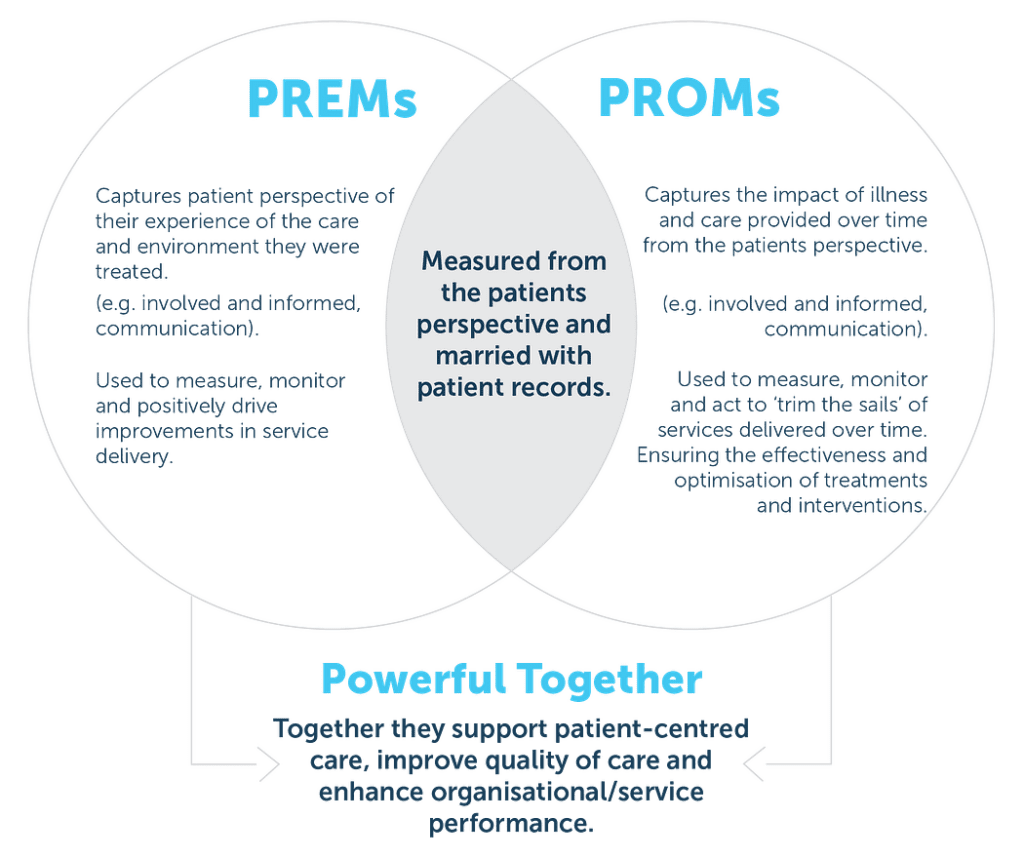
Reference –https://www.cemplicity.com/blog/how-do-prems-and-proms-work-together
PREM in Action: Real Examples.
A functional PREM questionnaire may ask questions like “How good was your practitioner at making you feel at ease?” or “Did staff explain things clearly?” Responses are scored on a five-point scale from poor to excellent. Hospitals utilize aggregated PREM data in quality improvement initiatives, aiming to enhance patient-centeredness across all departments.
For instance, the CARE measure is a relational PREM tool focusing on the quality of interactions between patients and practitioners. PREMs allow hospitals to compare different departments or practitioners, identify communication gaps, and drive policies that better respect and involve patients at every stage of their care.
PROM in Action: Real Examples.
PROMs tap into patient voices regarding their actual health outcomes post-treatment. Tools often used include validated scales for pain levels, depression, chronic illness symptoms, and mobility improvements. Hospitals adopt PROMs, such as the “Starting the conversation” diet intake measure or “Exercise as the fifth vital sign,” to assess health status directly from the patient’s viewpoint.
An extensive hospital network, for example, used PROMs to monitor recovery and quality-of-life improvements after joint replacement surgeries. Through regular patient self-reports, they were able to fine-tune postoperative care protocols and achieve better mobility outcomes, showcasing PROM as an accurate innovation benchmark.
Innovation Benchmarks in Modern Hospitals.
PREM and PROM are increasingly integrated into digital platforms and electronic health records. Hospitals utilize automated surveys, mobile apps, and wearable devices to collect ongoing patient feedback. This data is analyzed using intelligent algorithms to reveal trends, highlight outliers, and prompt real-time clinical improvements.
Innovation benchmarks using PREM and PROM include:
- Improving doctor-patient communication pathways.
- Creating personalized care plans driven by patient feedback.
- Linking reimbursement and incentives to actual patient-reported experiences and outcomes.
- Involving patients in developing new PREM and PROM tools for better context and relevance.
- Enhancing teamwork, care coordination, and responsiveness to pain and patient preferences.
Real World Case Study: PROM & PREM Implementation.
A large European teaching hospital deployed both PREM and PROM systems for outpatient specialty clinics. PREM data revealed patients wanted clearer information post-consultation, while PROM data highlighted recovery bottlenecks among certain surgical wards. By combining insights, the hospital refined its discharge protocols and enhanced interdisciplinary communication, resulting in improved patient experience ratings and health outcomes scores. This case serves as a benchmark for innovation, demonstrating the power of direct patient voices, data-driven policies, and feedback loops in modern healthcare.
Conclusion: Patient Voices at the Heart of Innovation.
PREM and PROM transform hospitals into learning organizations, constantly measuring, listening, and evolving. By treating PREM and PROM as innovation benchmarks, hospitals can provide genuine patient-centred care, set global standards, and ensure that every voice in the hospital system matters.
References.
- https://www.talkinghealthtech.com/glossary/patient-reported-experience-measures-prems
- https://www.actuvi.com/blog/prems-and-proms
- https://www.safetyandquality.gov.au/our-work/indicators-measurement-and-reporting/patient-reported-outcome-measures
- https://pmc.ncbi.nlm.nih.gov/articles/PMC4089835/
- https://www.caho.in/files/CAHO-White-paper-on-validated-PREMs.pdf
- https://pmc.ncbi.nlm.nih.gov/articles/PMC11600902/
- https://patientreportedoutcomes.ca/what-are-pros/prom-examples/
- https://www.lime.health/en/blog/hospital-4-sectors-where-prems-proms-make-a-difference
About The Author


