
Table of Contents
Introduction: Why Economics Matters in Health.
Economics, at its core, is about how societies allocate limited resources to meet competing needs and demands. Health, being one of the most vital human needs, requires an efficient and fair allocation of resources, especially in today’s world, where health disparities are increasing and resources are becoming increasingly scarce. The subject of “Basic Economics and Health Economics” has become essential not only for students but also for policymakers, hospital administrators, NGOs, healthcare investors, and public health professionals worldwide.
This comprehensive guide explores key economic concepts and their applications to the health sector, using global examples, real-life case studies, and critical analysis to enhance understanding for a broad audience.
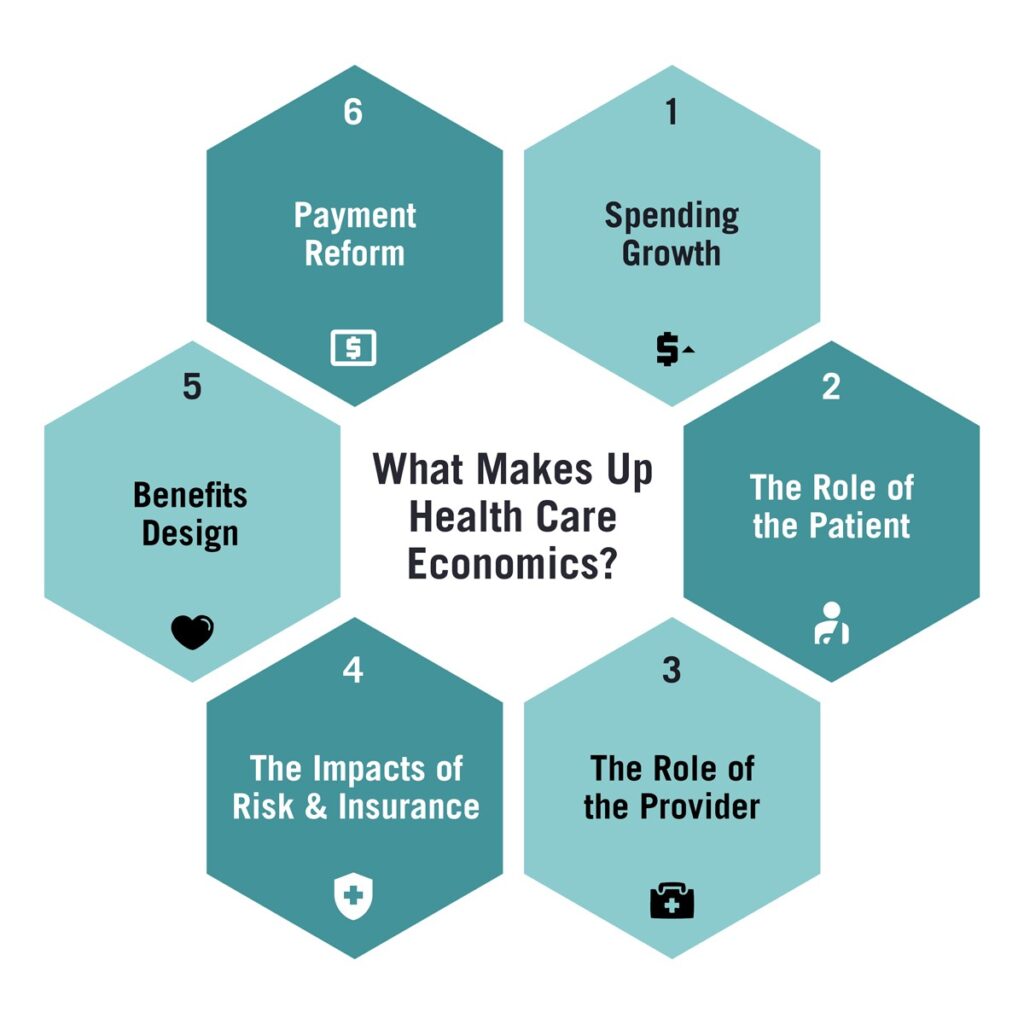
1. Foundations of Basic Economics: A Refresher for Everyone.
- 1.1 Scarcity and Choice in a Health Context
Scarcity refers to the limited availability of resources in the face of unlimited human wants. Every government, hospital, and healthcare provider must make choices about whether to invest in primary healthcare, build new hospitals, purchase modern equipment, or improve workforce training.
Example: During the COVID-19 pandemic, countries faced a scarcity of ICU beds and ventilators, forcing hospitals to make difficult choices about who receives intensive care support.
- 1.2 Opportunity Cost: The Cost of Every Health Decision
Opportunity cost refers to the value of the best alternative that you forgo when choosing one option over another.
Example: If the government allocates $100 million for establishing an AI-based diagnostics system, the opportunity cost could be underfunding rural health centers, where more immediate lives could be saved.
- 1.3 Supply and Demand in Health Markets
- Demand: How much healthcare people want at a given price.
- Supply: How much service providers offer.
In healthcare, demand tends to be inelastic. People seek care even when prices are high or when they lack the ability to pay.
Example: Emergency care during a heart attack is sought regardless of cost.
- 1.4 Market Failures in Healthcare
Health markets often do not behave like regular markets. Reasons include:
- Information asymmetry: Patients don’t have the same knowledge as doctors.
- Externalities: A vaccinated person reduces the transmission of disease to others.
- Public goods: Services like clean air or sanitation cannot be provided profitably by private markets.
This justifies the intervention of governments and NGOs in the provision of health services.
- 1.5 Types of Goods in the Health Sector
- Private Goods: Medications, consultations consumed individually.
- Public Goods: Vector control, pandemic surveillance.
- Merit Goods: Education, vaccinations under-consumed if left to markets.
Understanding these distinctions helps develop better funding models.
2. Health Economics: The Science Behind Smart Healthcare Decisions.
Health Economics examines how societies produce, distribute, and consume healthcare. Its goal is to enhance efficiency, effectiveness, and fairness in health services.
- 2.1 What Makes Health Different as a Commodity?
Health is a right, not just a market product. Its unique traits include:
- Essential nature: People cannot opt out.
- Uncertainty: Timing and severity of illness are unpredictable.
- Information asymmetry: Patients depend on providers for knowledge.
Example: Patients undergoing surgery often do not know all the risks or costs involved. They trust
doctors and health systems to guide them ethically.
| Country | Model | Features |
| UK | Beveridge | Tax-funded, universal access |
| Germany | Bismarck | Insurance-based, employer-employee contributions |
| USA | Private insurance | Market-driven, high inequality |
| India | Mixed | Public + private + out-of-pocket |
India’s health financing system heavily relies on out-of-pocket expenses (OOPE), which lead to catastrophic healthcare costs, particularly for low-income populations.
- 2.3 The Three E’s: Efficiency, Equity, and Effectiveness
- Efficiency: Best use of resources to maximize outcomes.
- Equity: Fair access regardless of income, gender, or geography.
- Effectiveness: Meeting health goals successfully.
Example: Vaccination drives in urban slums can be inefficient (with a high cost per person), but they can also be equitable and life-saving.
3. Economic Evaluation Tools in Health Policy.
Healthcare systems must prioritize interventions. Health economics offers evaluation methods:
- 3.1 Cost-Effectiveness Analysis (CEA)
Measures cost per health gain (e.g., cost per life saved).
Example: Comparing the cost of polio vaccination vs. long-term treatment of polio cases.
- 3.2 Cost-Utility Analysis (CUA)
Uses QALYs (Quality Adjusted Life Years) or DALYs (Disability Adjusted Life Years) to measure value.
Example: An anti-hypertension drug may extend life by 5 years with high quality, justifying higher cost.
- 3.3 Cost-Benefit Analysis (CBA)
Expresses both costs and benefits in monetary terms.
Example: A cancer screening program that saves ₹1,000 crore in treatment costs vs. ₹200 crore in implementation costs.
These tools help ministries, donors, and NGOs prioritize programs based on evidence rather than guesswork.
4. Insurance, Risk, and Health Markets.
- 4.1 Role of Insurance in Health Economics
Health insurance pools risks and lowers financial uncertainty. However, it also introduces risks of moral hazard and adverse selection.
- Moral Hazard: People overuse services because they’re insured.
- Adverse Selection: Individuals with pre-existing health conditions are more likely to purchase insurance.
Global Example: In the U.S., high premiums and insurance denials for pre-existing conditions led to health inequities prior to the Affordable Care Act.
- 4.2 Public vs. Private Insurance
- Public Insurance ensures universal coverage but may face underfunding.
- Private Insurance offers more options but increases inequality.
India’s Ayushman Bharat (PMJAY) is a publicly funded insurance program that has increased access but faces criticism for favouring private hospitals and not sufficiently focusing on preventive care.
5. Global Standards and Country Comparisons.
- 5.1 Universal Health Coverage (UHC)
UHC ensures that everyone receives the necessary health services without facing financial hardship. As per WHO, key elements include:
- Equity in access
- Quality services
- Financial protection
Rwanda, despite its limited resources, has achieved impressive UHC indicators through strong community health worker programs and social insurance.
- 5.2 Global Health Expenditure Benchmarks
- India: ~1.3% of GDP on public health
- WHO recommendation: 5% of GDP
- Norway: ~9% of GDP, with strong public healthcare
- 5.3 Case Study: Thailand’s Health Transformation
Thailand introduced Universal Coverage Scheme (UCS) in 2002, offering free health services to its population.
Outcomes:
- Out-of-pocket spending dropped by 70%
- Maternal mortality declined
- Health equity improved
It used robust cost-benefit evaluations and decentralized planning.
6. Health Workforce and Economic Challenges
- 6.1 Labor Economics in Health
Health professionals are often unevenly distributed. Urban areas attract more doctors, leaving rural populations underserved.
Incentives such as rural allowances, career growth opportunities, and improved facilities are necessary to address these imbalances.
- 6.2 Migration and Brain Drain
India produces thousands of doctors and nurses annually, but many migrate to OECD countries for better pay.
Solution: Improve domestic health systems, offer decent wages, and create career pathways.
7. Indian Scenario: Challenges and Innovations.
7.1 India’s Public vs. Private Sector
- Public sector: Underserved, especially in infrastructure
- Private sector: Overused by the rich, under-regulated
Blending both effectively is crucial for sustainable UHC.
7.2 Innovations in Financing
- Health cess on goods to finance national programs
- Digital health IDs to reduce duplication and fraud
7.3 The Need for Preventive Economics
Every ₹1 spent on prevention saves ₹4–5 on treatment.
- Early diabetes screening
- Anti-tobacco campaigns
- Water sanitation in rural areas
These preventive efforts are economically and socially justifiable.
8. Relevance for Stakeholders Beyond Students.
- Policymakers utilize health economics to inform evidence-based budgeting.
- Hospital managers design cost-saving protocols.
- Insurance companies create better risk models.
- NGOs plan sustainable, impactful programs.
- Academics and researchers develop tools to inform and optimize decisions.
Even citizens benefit from understanding health economics to demand accountability, advocate for their rights, and make better personal health choices.
Conclusion: Toward Smarter, Fairer, Healthier Systems.
Health economics isn’t about making profits; it’s about making smarter choices for healthier communities. Whether choosing between two life-saving programs, evaluating hospital budgets, or developing public health laws, economic tools help ensure resources are used wisely, fairly, and efficiently.
In an era of global health crises, climate emergencies, and rising costs, health economics is now essential and fundamental.
References.
- Arrow, K. J. (1963). Uncertainty and the Welfare Economics of Medical Care. American Economic Review, 53(5), 941–973.
- Drummond, M. F., Sculpher, M. J., Claxton, K., Stoddart, G. L., & Torrance, G. W. (2015). Methods for the Economic Evaluation of Health Care Programmes. Oxford University Press.
- World Health Organization (2010). Health Systems Financing: The Path to Universal Coverage.
- Ministry of Health and Family Welfare, Government of India. (2022). National Health Accounts Estimates for India.
- Sen, A. (2002). Health: Perception versus Observation. BMJ, 324(7342), 860–861.
- Sachs, J. (2012). Achieving Universal Health Coverage in Low-Income Settings. Lancet, 380(9845), 944–947.
- World Bank (2023). Health Equity and Financial Protection Indicators Database.
About The Author


