

Table of Contents
Virtual and Augmented Reality are no longer science fiction; they are revolutionizing industries, particularly the healthcare sector. Immersive technologies are now opening new doors in medical training and patient care, providing unprecedented means for learning, education and healing. Through the fusion of digital and real-world realities, VR and AR enable health professionals to model real-life situations, improve clinical skills and provide tailored treatments.
In medical education, VR creates simulated environments in which surgeons can hone skills without endangering patients and AR superimposes digital data on actual environments to enhance learning situations with real-time information. In addition to education, VR is revolutionizing patient care; relieving chronic pain and providing new avenues for the treatment of mental illnesses such as post-traumatic stress disorder (PTSD). These technologies not only are improving outcomes but are also dismantling barriers to higher levels of care, particularly among underserved and rural communities.
We’re going to examine the most important fields VR and AR are transforming health care eg. pain management, surgery simulation and the treatment of PTSD. Let’s dive into real-world usage, hot spots today and the potential for what this technology can do to transform the way we treat patients and train health care professionals.
Understanding Virtual and Augmented Reality in Healthcare
Virtual Reality (VR) and Augmented Reality (AR) are both immersive, though distinct, technologies in terms of how they combine digital and physical experiences.
- VR creates a fully immerged, computer-generated reality that is experienced by the user through specialist headsets and controllers. It withdraws the user from the real world, re-creating conditions for training and therapy within a highly contained environment.
- AR, however, superimposes digital objects – images, information, or 3D models – onto the physical world through devices such as smartphones, tablets, or AR glasses. AR is different from VR in that it augments the real world instead of replacing it and it delivers contextual information in real time.
In healthcare, VR and AR provide special capabilities that are revolutionizing patient care and medical education by:
- Simulation: Both AR and VR allow realistic simulations for practice in the clinic. VR allows virtual operating theaters and patients and doctors can practice in a risk-free setup. AR facilitates real-time anatomy visualization during operations, enhancing accuracy and minimizing mistakes.
- Visualization: Users can see detailed anatomical structures in 3D using VR, seeing entirely new perspectives which are not possible using 2D images. AR offers more visualization in surgery, enabling the surgeon to see visually under the skin without an incision, allowing for better accuracy and patient results.
- Interactive Learning: These technologies enable experiential learning. Surgical procedures can be rehearsed multiple times in VR by medical students until they are proficient and AR provides real-time feedback while performing clinical procedures, closing the gap between theory and practice.
By merging these critical functionalities, VR and AR are rendering healthcare training more interactive, immersive and effective, which ultimately results in better patient safety and clinical outcomes.
Applications of Surgical Training: A New Era of Precision and Practice
Augmented Reality (AR) and Virtual Reality (VR) are transforming surgical training by offering life-like and interactive spaces where doctors can hone their skills without the risk of exposing patients to complications. Conventional training methods make use of textbooks, cadavers, or simply observing, whereas VR and AR provide interactive and hands-on modes that facilitate faster learning and improved confidence.
VR in Surgical Training
VR surgical simulations produce hyper-realistic, interactive space that is fundamentally models of operation rooms, equipped with virtual patients and surgical equipment. Surgeons are able to repeat complex operations again and again, making errors without penalty. Simulations are immediate in offering feedback on one’s performance, allowing trainees to develop muscle memory and fine-tune one’s skills.
Main Advantages of Using VR in Surgery Training
- Improved Accuracy: Simulations allow surgeons to better learn anatomy and procedural work flows, resulting in fewer mistakes when performing live surgeries.
- Risk-Free Practice: Trainees can practice low-frequency or risky procedures without jeopardizing patients.
- Greater Confidence: Repeated performances in a risk-free environment help medical professionals build confidence before performing procedures on real patients.
Software such as Osso VR and Surgical Theater is revolutionizing surgical training. Osso VR contains an online library of orthopedic and general surgery simulations, which trainees can use to rehearse step-by-step procedures. Surgical Theater, meanwhile, employs VR to build 3D reconstructions of a patient’s anatomy, which surgeons can use to plan and rehearse operations with unheralded precision.
AR in Surgical Training
Augmented Reality improves live surgery by overlaying critical information e.g., anatomical features or surgical landmarks onto the surgeon’s field of view. Real-time guidance eliminates guesswork and minimizes error. For example, AR can mark blood vessels or tumors under the skin, enabling surgeons to make better decisions during minimally invasive procedures.
Main Benefits of AR in Surgical Training
- Real-Time Visualization: AR allows for visualization of internal structures without requiring extra imaging, shortening operating time.
- Enhanced Collaboration: Surgeons can remotely share AR views with colleagues, enabling real-time guidance and second opinions.
- Improved Patient Outcomes: Increased accuracy and fewer errors lead to improved recovery times and overall patient safety.
The Microsoft HoloLens is widely used for surgical training to allow trainees to explore 3D anatomy while interacting with real-world surroundings. Touch Surgery is another AR platform that delivers step-by-step surgical instructions to improve surgical preparation and confidence.
With the implementation of VR and AR in surgical training, health care providers are able to achieve higher levels of accuracy, competence and readiness ultimately improving the standard of patient care.
VR and AR Pain Management: Innovating Pain Therapy through Immersion
Virtual Reality (VR) is increasingly proving to be an asset in pain management, providing medication-free, non-pharmacological therapy for chronic and acute pain patients. Through patient engagement in calming, interactive settings, VR serves as distraction therapy, pain perception reduction and enhanced quality of life. In contrast to conventional pain management methods that heavily depend on drugs, VR presents an alternative with fewer side effects.
VR as Distraction Therapy
Pain is usually enhanced by psychological variables such as concern and attention to pain. VR takes advantage of the limited attentional capacity of the brain, filling it with engaging virtual environments and distracting it from pain. Virtual environments like peaceful landscapes, engaging games, or soothing underwater scenes evoke positive affect states, causing patients to relax and diminish their perception of pain.
Applications in Acute Pain
VR therapy is particularly useful for the management of acute pain, like that felt by burn patients undergoing wound treatment and physical therapy. Standard treatments for such patients are usually painful, but VR can reduce perceived pain by as much as 50%.
SnowWorld, a software program for burn patients, brings gamers into a snow world within a virtual reality in which they can engage in a snowball battle with penguins and snowmen. This diversion eliminates the need for huge amounts of painkillers for painful dressing on painful wounds. Patients are shown to be indicating reduced pain when in this virtual world.
VR for Chronic Pain
Chronic pain conditions like phantom limb pain and fibromyalgia are extremely hard to treat. VR is a new way of treating this by reprocessing the pain signals in the brain. For people with phantom limb pain, employing VR can mimic having the missing limb and assist “retraining” the brain so that pain will be reduced. In phantom limb therapy, VR equipment creates a virtual limb that mirrors the patient’s movements and the visual feedback reduces pain perception. The same techniques have been effective in managing CRPS and other chronic pain disorders.
The Future of AR in Pain Management
While VR takes the lead in distraction therapy, Augmented Reality (AR) holds promise for physical rehabilitation and the management of chronic pain. AR programs are able to instruct patients through exercise therapy with instant feedback, enhancing compliance and outcomes.
With its potential to provide immersive and interactive experiences, VR is not just assisting patients to prevent pain but also giving clinicians a tool to enhance care in general and mitigate opioid dependency.
VR and AR as Treatment for PTSD and Mental Health: A New Therapeutic Frontier
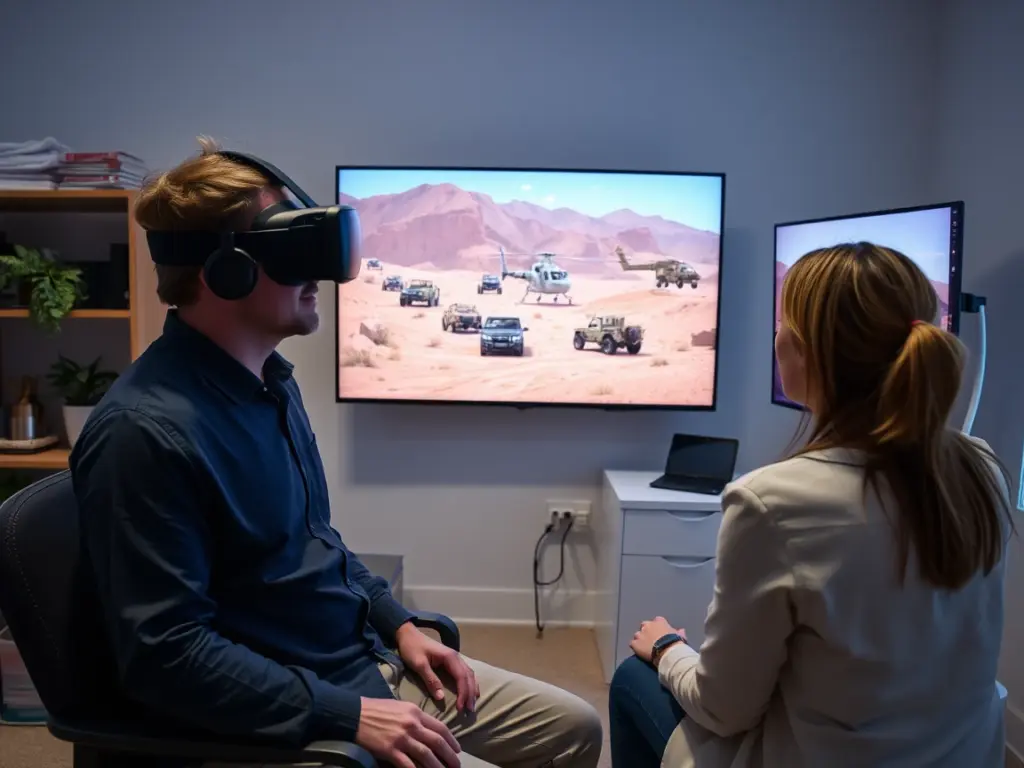
Virtual Reality (VR) is revolutionizing mental health therapy with the provision of safe, controlled spaces for exposure therapy, especially for treating post-traumatic stress disorder (PTSD) anxiety and phobias. Conventional therapy involves imagination or verbal description of the traumatic experience, which might be too weak or boring for some patients. VR offers a novel solution in recreating authentic situations where patients can face and work through their trauma on their own pace.
VR Exposure Therapy for PTSD
VR exposure therapy (VRET) treats individuals with PTSD by exposing them to simulated scenarios of their traumatic event in a safe and controlled environment. The simulations are customized to resemble the individual’s personal trauma, which enables therapists to desensitize them gradually to stimuli and weaken their emotional response.
Bravemind, developed by the University of Southern California’s Institute for Creative Technologies, is a form of VR therapy used to treat combat veterans suffering from PTSD. The patients are exposed to combat scenarios that simulate what they experienced; complete with realistic sights, sounds and vibration. Studies show that Bravemind has a significant impact in decreasing PTSD symptoms and increasing coping ability.
Use in Treating Anxiety and Phobias
VR is also employed to treat anxiety disorders and phobias of all kinds by recreating the feared world in a controlled environment. The patient is able to face their fears, flying, public speaking, or heights to name a few; while a therapist provides support and guidance. The controlled environment of VR allows patients to more easily face and overcome their anxiety than with standard cognitive-behavioral therapy.
A patient suffering from flying phobia would utilize VR to simulate takeoff, turbulence and landing in an imaginary plane. By means of repeated exposure, their fear is reduced as they get used to the experience in a gradual manner.
Ongoing Research and Success Stories
Therapeutic uses of VR in mental illnesses are currently under research. Its use in the treatment of social anxiety disorder, depression and addictions is being tested. Early findings are encouraging, with patients showing good improvement in symptoms and enhanced emotional resilience.
Success stories about former military personnel, emergency responders and extreme phobiacs demonstrate just how mainstream virtual reality is coming to be adopted as a sure and effective new alternative in mental health care. As these technologies continue to develop, they present new promises to those under threat of mental disease, filling in the gap between old-school therapy and new high-tech methods.
Conclusion: The Future of Healthcare Through Immersive Technologies
Virtual Reality (VR) and Augmented Reality (AR) are revolutionizing the healthcare environment, introducing leading-edge technologies that improve medical education and patient care. From surgical training to pain management and mental health treatment, these technologies provide immersive, interactive experiences that enhance accuracy, enhance patient outcomes and expand access and effectiveness to care.
By enabling realistic simulation, real-time visualization and tailored therapy, VR and AR are equipping healthcare professionals with new technologies to boost their skills and deliver improved treatments. The success of PTSD therapy, treating chronic pain and surgical training illustrates the revolutionary power of immersive technology in addressing some of the most intractable healthcare issues.
As the technologies in general continue to mature, so will their potential. Greater use, continued research and incorporation into mainstream healthcare practice will release even more potential. The future of health with VR and AR is one of a world where training is improved, therapy is tailored and patient care is more compassionate and effective than ever before.
Further Reading
About The Author


