
Table of Contents
Optimizing Revenue Cycle Management (RCM) is the financial backbone of any healthcare organization, ensuring that hospitals can sustain operations, invest in infrastructure, and deliver quality care. In India, where healthcare systems are diverse and complex, optimizing RCM is critical for government and private hospitals. This article provides an analytical exploration of RCM challenges, strategies for optimization, and the role of digital initiatives like the Ayushman Bharat Digital Mission (ABDM), National Health Claim Exchange (NHCX), and Public Financial Management System (PFMS). Drawing from case studies of hospitals like Fortis, Manipal, and District Hospital Jaipur, we outline a comprehensive framework for RCM 2.0 to enhance financial efficiency and patient satisfaction.
The RCM Challenge: Government vs. Private Hospitals.
- Government Hospitals
Government hospitals, such as the District Hospital Jaipur or Civil Hospital Mumbai, rely heavily on reimbursements from schemes like Ayushman Bharat (PMJAY) and state-specific programs. However, delays in claim settlements, averaging 45–60 days, create cash flow bottlenecks. A 2023 National Health Authority (NHA) report revealed that 35% of claims in public hospitals are rejected due to documentation errors, leading to significant revenue leakage.
- Private Hospitals
Private hospitals like Fortis and Manipal face different but equally pressing challenges. Coordination with Third-Party Administrators (TPAs) is often flawed, paperwork is complex, and revenue leakage is common due to high denial rates (10–15%). These hospitals also struggle with manual claims processing and a lack of real-time analytics, which hampers their ability to identify and address financial inefficiencies.
Root Causes of RCM Inefficiencies
- Fragmented Workflows: Lack of a unified system for patient registration, billing, and claims processing.
- Poor Documentation: Inaccurate coding and incomplete discharge summaries, often due to overburdened staff.
- Manual Processes: Reliance on paperwork at every stage increases errors and delays.
- High Denial Rates: Claims are frequently rejected due to non-compliance with scheme guidelines or coding errors.
- Lack of Analytics: Absence of data-driven insights to pinpoint where revenue is lost.
For instance, a medical college hospital discovered through an MRD (Medical Records Department) audit that ₹1.2 crore in claims were rejected solely due to incomplete discharge summaries, highlighting the scale of the problem.
RCM 2.0: A Five-Layer Optimization Framework.
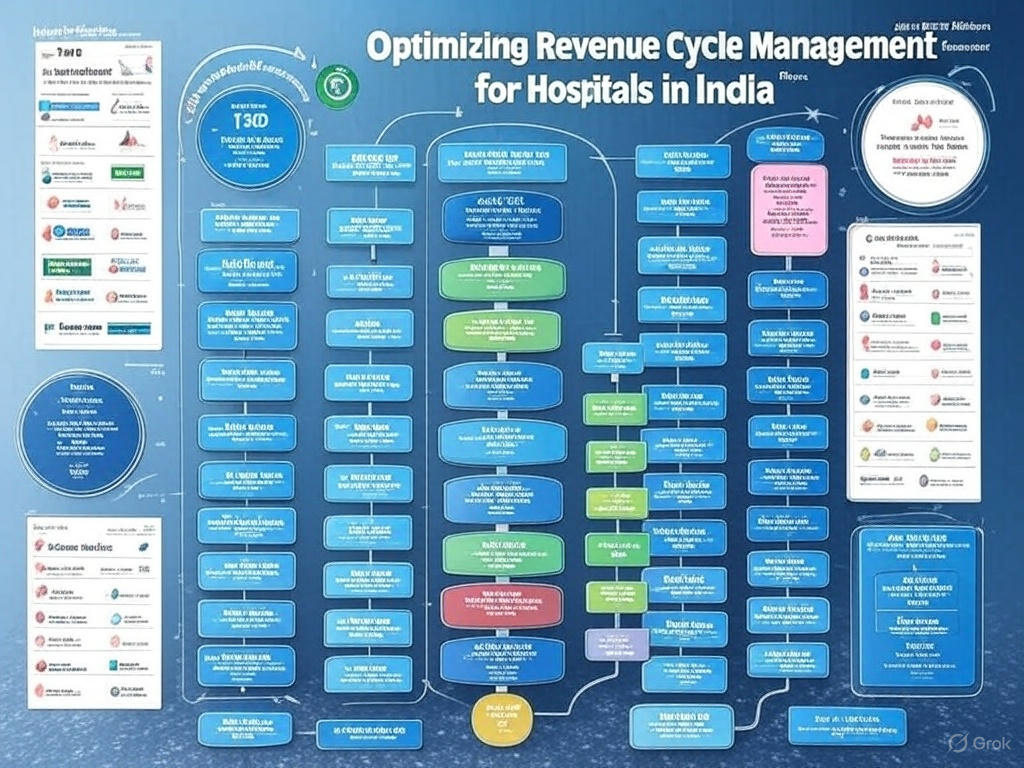
To address these challenges, we propose the Smart RCM Model, a five-layer framework tailored for Indian hospitals, integrating digital tools and best practices.
1. Front-End Optimization.
- Digital Registration: Implement systems for seamless patient onboarding, linked to Ayushman Bharat Health Accounts (ABHA) for unique identification.
- Real-Time Eligibility Checks: Verify coverage under PMJAY, CGHS, or private insurance at the point of entry.
- Scheme Counselling: Educate patients on covered services to reduce out-of-pocket expenses and disputes.
Case Study: Select district hospitals in Rajasthan integrated the Integrated Health Management System (iHMS) with PMJAY’s Transaction Management System (TMS), reducing claim rejections by 22% within three months.
2. Mid-Cycle Management.
- Clinical Templates: Standardize documentation with pre-built templates to ensure compliance with coding standards.
- Computer-Assisted Coding (CAC): Use CAC tools to minimize coding errors and improve billing accuracy.
- Staff Training: Regular training on coding practices and scheme guidelines to reduce errors.
Example: An NABH-accredited hospital adopted CAC tools, reclaiming ₹80 lakh in annual revenue through improved coding accuracy.
3. Back-End Automation.
- NHCX Integration: Leverage the National Health Claim Exchange (NHCX), a digital platform under ABDM, for faster and standardized claim submissions.
- Real-Time Denial Dashboards: Monitor claim rejections in real-time to address issues promptly.
- Electronic Remittance Processing: Automate payment reconciliation to reduce manual errors.
Case Study: Uttarakhand state hospitals linked billing to the Public Financial Management System (PFMS), cutting claim processing time by 50%.
4. Cost Centre Accounting.
- Department-Wise Mapping: Track revenue and costs by department (e.g., dialysis, radiology, OT) to identify profitable units.
- Resource Optimization: Analyze utilization reports to maximize high-revenue services.
Example: A medium-sized hospital analyzed its OT utilization report and found that only 62% of slots were used, leading to a potential revenue loss of ₹25 lakh. By optimizing scheduling, they recovered this revenue.
5. Digital Integration and Automation.
- Robotic Process Automation (RPA): Use RPA bots to automate repetitive tasks like discharge billing.
- AI for Fraud Detection: Deploy AI to flag suspicious claims and reduce fraud.
- Cloud-Based RCM Dashboards: Provide real-time visibility into financial performance.
Case Study: A 150-bed hospital in Chennai implemented RPA for discharge billing, saving 30% of administrative time and ₹18 lakh annually.
Impact of Optimized RCM.
- For Government Hospitals
- Faster Reimbursements: Streamlined processes reduce claim settlement times, improving cash flow.
- Scheme Compliance: Better adherence to PMJAY and state scheme guidelines minimizes rejections.
- Efficient Budgeting: Data-driven insights enable better resource allocation.
- For Private Hospitals
- Reduced Accounts Receivable (AR) Days: Faster claim processing improves liquidity.
- Increased Working Capital: Recovered revenue supports infrastructure upgrades.
- Investor Confidence: Transparent financials attract funding.
Analysis: A Delhi-based hospital chain implemented a denial analytics dashboard, recovering ₹2.5 crore in four months by addressing claim rejections proactively.
Stakeholders and Benefits.
- Providers:
- Real-time visibility into financial performance.
- Reduced administrative workload through automation.
- Improved profitability by minimizing revenue leakage.
- Insurers and Government Schemes:
- Timely and accurate data for policy planning.
- Reduced fraud through standardized processes.
- Simplified audits with digital records.
- Patients:
- Faster claim approvals, reducing wait times.
- Transparent billing for better trust.
- Enhanced experience with seamless processes.
Case Study: A community health center adopted digital RCM, enabling same-day scheme approvals and increasing patient satisfaction from 74% to 92%.
The Role of ABDM, NHCX, and PFMS.
- Ayushman Bharat Digital Mission (ABDM): Launched in 2021, ABDM creates a national digital health ecosystem with ABHA, enabling seamless data exchange and interoperability. Over 67 crore ABHA accounts and 42 crore linked health records have been created as of September 2024.
- National Health Claim Exchange (NHCX): NHCX standardizes claim processing, reducing costs (from ₹500 to ₹20 per claim) and improving transparency. Hospitals like Fortis and Narayana Hrudayalaya have completed NHCX integration, enhancing efficiency.
- Public Financial Management System (PFMS): PFMS streamlines government reimbursements, ensuring timely payments and better financial tracking for public hospitals.
Conclusion and Recommendations.
RCM is no longer just an accounting function; it is a strategic priority for hospital leadership. To thrive in India’s evolving healthcare landscape, hospitals must adopt a digital-first RCM approach. Key recommendations include:
- State-Level RCM Planning: Develop region-specific strategies to address local challenges.
- Integration with ABDM, NHCX, and PFMS: Leverage these platforms for interoperability and efficiency.
- Staff Training: Invest in continuous training on documentation, coding, and scheme compliance.
- Technology Adoption: Embrace RPA, AI, and cloud-based dashboards to automate and optimize processes.
By implementing the Smart RCM Model, hospitals can transform their financial operations, reduce revenue leakage, and enhance patient care. The time to act is now—embrace digital RCM to build a financially robust healthcare ecosystem.
References.
- National Health Authority (NHA). (2023). Ayushman Bharat Digital Mission Progress Report.
- Express Healthcare. (2023). NHA Organises Accelerator Workshops on ABDM Integration and NHCX Adoption.
- Pharmbills. (2024). Strategies for Healthcare Revenue Cycle Optimization in 2025.
- India Insurtech. (2024). National Health Claim Exchange (NHCX): The Future of Health Insurance in India.
- Vikaspedia. (2022). Ayushman Bharat Digital Mission Overview.
About The Author


