The Missing Link in India’s Healthcare System.
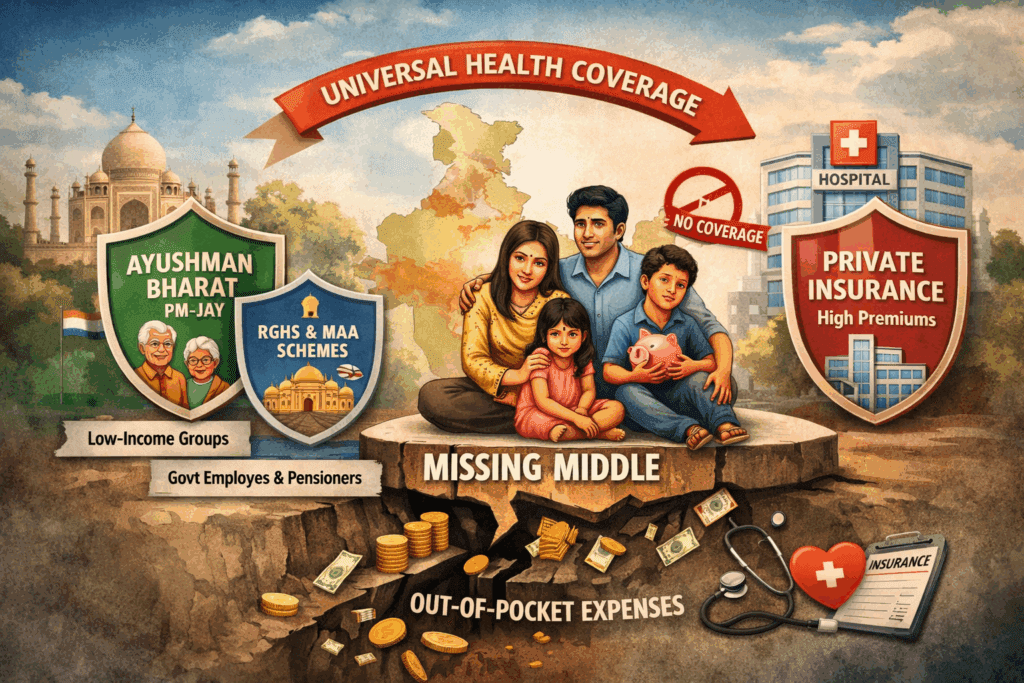
India’s healthcare system has undergone a significant transformation over the past decade, with major policy initiatives such as Ayushman Bharat expanding access to millions. However, a critical gap persists-the “missing middle.” The issue of health insurance for India’s missing middle highlights a structural imbalance where a large segment of the population remains financially unprotected.
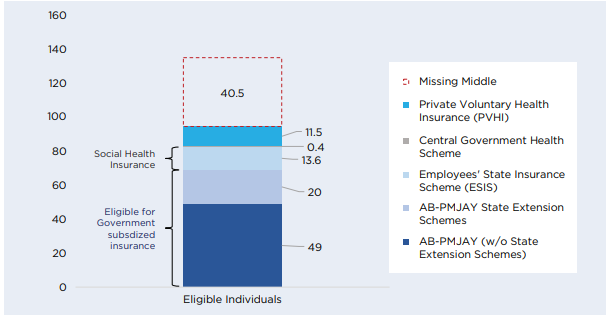
According to NITI Aayog estimates, nearly 30% of India’s population (around 40 crore people) falls into this category. These individuals are not eligible for government-supported schemes and cannot afford private insurance. As a result, they face high financial risks during medical emergencies, making this one of the most pressing healthcare challenges in India today.
Understanding the Missing Middle.
The missing middle is not a small or homogeneous group-it represents a wide section of society.
Who does it include?
- Lower-middle-income households
- Informal sector workers and gig economy participants
- Small business owners and self-employed individuals
Key Characteristics :
- Exclusion from Government Schemes: Their income levels place them just above eligibility thresholds.
- Limited Affordability: Rising healthcare costs make private insurance premiums difficult to sustain.
- High Financial Vulnerability: Even minor health issues can disrupt household finances.
This makes health insurance for India’s missing middle a structural challenge requiring targeted solutions.
The Data Behind the Crisis: Out-of-Pocket Expenditure (OOPE).
India continues to face a high burden of out-of-pocket expenditure (OOPE), which reflects gaps in financial protection.
Key Data Points :
- 48–55% of Total Health Expenditure is Out-of-Pocket:
Nearly half of healthcare spending is borne directly by households, indicating weak insurance penetration. - 5–7% of Households Fall into Poverty Annually Due to Medical Costs:
Healthcare expenses are a major cause of financial distress and poverty in India. - Rural-Urban Disparity:
Rural households often spend a higher proportion of income on healthcare due to limited access and delayed treatment.
Implications:
- Delayed healthcare-seeking behaviour
- Increased disease burden
- Financial instability and debt
Insight: High OOPE clearly shows that expanding health insurance for India’s missing middle is both a healthcare and economic priority.
National Framework: Ayushman Bharat (PM-JAY).
Ayushman Bharat has been a landmark initiative in India’s healthcare system.
Key Features:
- ₹5 lakh coverage per family annually
- Focus on secondary and tertiary care
- Cashless hospitalization
Recent Data:
- Over 43 crore beneficiaries enrolled
- More than 6 crore hospital admissions covered
Limitations (Elaborated):
- Exclusion of the Missing Middle: Designed primarily for economically weaker sections.
- Hospitalization-Centric Coverage: Limited support for OPD, diagnostics, and preventive care.
- Implementation Variability: Differences in state-level execution affect outcomes.
While impactful, it does not fully address health insurance for India’s missing middle.
Rajasthan Model: A Multi-Layered Approach.
Rajasthan has emerged as a strong example of combining schemes to expand healthcare coverage.
1. Rajasthan Government Health Scheme (RGHS)
RGHS provides cashless healthcare to government employees and pensioners.
Key Features (Elaborated):
- Comprehensive Coverage: Includes OPD, IPD, diagnostics, and medicines.
- Cashless Treatment: Available in empanelled hospitals, reducing upfront financial burden.
- Standardized Packages: Ensures uniformity in treatment costs.
Challenges:
- Delayed Payments: Hospitals face reimbursement delays, affecting service continuity.
- Operational Issues: Temporary suspension of services has been observed.
- Fraud Risks: Misuse of beneficiary cards impacts system efficiency.
Insight: RGHS highlights the importance of comprehensive coverage but also the need for strong governance mechanisms.
2. Mukhyamantri Ayushman Arogya Yojana (MAA)
This scheme integrates state and central insurance systems.
Highlights:
- Expands coverage beyond BPL population
- Offers cashless hospitalization
- Enhances accessibility
Limitations:
- Interstate portability challenges
- Operational inefficiencies
3. Digital Integration (ABHA ID)
- Enables digital health records
- Improves transparency and tracking
- Supports data-driven policy decisions
Rajasthan demonstrates both innovation and implementation challenges in healthcare insurance.
Other State-Level Health Insurance Models.
India’s federal structure has led to diverse models across states:
Tamil Nadu – CMCHIS
- Covers low and middle-income groups
- Strong hospital network
- Efficient claim settlement
Key Strength: Better trust and implementation
Telangana – Aarogyasri
- Focus on critical illnesses
- Strong tertiary care coverage
Limitation: Limited OPD services
Maharashtra – MJPJAY
- Focus on rural populations
- Strong public-private partnerships
Karnataka – Yeshasvini Scheme
- Cooperative-based insurance model
- Low premium, high participation
Innovation: Community-driven approach
Delhi Model
- Free diagnostics and medicines
- Focus on strengthening public healthcare delivery
Insight: Insurance alone is not enough—service delivery matters as well.
Global Best Practices.
Countries across the world provide valuable lessons:
United Kingdom (NHS)
- Tax-funded healthcare
- Universal access
Germany
- Social insurance model
- Employer-employee contributions
Thailand
- Near-universal coverage
- Strong political commitment
United States (ACA)
- Subsidies for middle-income groups
Japan
- Mandatory insurance
- Regulated pricing
Key Learnings for India :
- Subsidies are essential for middle-income groups
- Risk pooling improves sustainability
- Regulation ensures affordability
- Hybrid models (public + private) are most effective
Why the Missing Middle Remains Excluded.
Despite multiple schemes, several challenges persist:
Structural Issues:
- High insurance premiums
- Lack of tailored products
- Fragmented system
Behavioural Issues:
- Low awareness
- Trust deficit
Systemic Issues:
- Delayed claim settlements
- Weak integration
This indicates a design-and-execution gap in health insurance for India’s missing middle.
Policy Reforms: The Way Forward.
1. Affordable Insurance Products
- Low-cost, modular plans
- Inclusion of OPD and diagnostics
2. Targeted Subsidies
- Partial premium support
- Inspired by global models
3. Integration of Schemes
- Unified digital platform
- Nationwide portability
4. Digital Health Ecosystem
- ABHA integration
- Real-time claims
- Fraud detection
5. Strengthening Primary Healthcare
- Focus on prevention
- Reduce hospitalization burden
Perspective: Bridging Policy and Practice
From a healthcare consulting perspective, the challenge is not just insurance-but system efficiency.
Key Contributions:
- Designing cost-efficient healthcare systems
- Integrating insurance workflows
- Reducing operational inefficiencies
- Promoting preventive healthcare
The goal is to ensure that insurance translates into real access and affordability.
From Coverage to True Healthcare Equity.
The issue of health insurance for India’s missing middle remains central to India’s healthcare transformation. While schemes like Ayushman Bharat and RGHS have expanded coverage, gaps in affordability, accessibility, and implementation persist.
Way Forward:
- Inclusive policy design
- Strong coordination between states and the center
- Financial sustainability
- Integration of global best practices
India’s journey toward Universal Health Coverage depends on how effectively it includes the missing middle. Only then can healthcare become accessible, affordable, and equitable for all.
About The Author


