
Table of Contents
Intangible assets and their role in future growth have become a crucial focus for hospitals aiming to enhance their competitive edge. More recently, intangible assets have been identified as key resources and sources of competitive advantage. It is argued that a sustainable competitive advantage results from the possession of resources that are inimitable, not substitutable, tacit in nature, and synergistic.
Tangible assets in healthcare are all the physical structure like building, clinic, equipments, all the inventories etc. Intangible assets are the ones which have no monetary value but yet it adds great value to the organization. International Accounting Standards Board defines an intangible asset as: an identifiable non-monetary asset without physical substance.
Understanding Intangible Assets and Their Role in Future Growth

The intangible assets are divided into human assets, relational assets & structural assets.
- Human Assets: Skills, sense of ownership, loyalty, competence of the employees, technical know how, expertise, attitude.
- Relational Assets: Relationship that the firm has with stakeholders, customers. Agreements, Contracts, Brand Image,
3. Structural Assets: All intangible assets that are associated with the organization like culture, processes, SOPs, electronic medical records, intellectual properties including patents, copyrights and trademarks.
In healthcare, mostly the intangible assets are relational assets like agreements / contracts with outsourced services, various professional licences, practice licenses & registration certificates, agreements with suppliers, administration, facility management, physicians, for using certain equipments etc, joint venture agreements and franchisee.
The Key Role of Intangible Assets in Healthcare Success
Whichever business you are in, how do you know that you are moving ahead in the right track ? How will you convince your stakeholders that the business is doing well? For this you need to have a thorough knowledge of your intangible or the strategic asset. The importance of intangible assets and their role in future growth is particularly evident in healthcare organizations striving to build sustainable operations.
The intangible assets do not have any monetary value, but in healthcare they play a very important role. The industries to which intangible asset plays an important role are:
- Technology: Apple, Samsung etc have built lots of intangible assets and because of which they have a competitive edge over the others. Patents, copyrights, franchisee etc are their key intangible assets.
- Entertainment: Entertainment & media have copyright asset. Lots of music companies have copyright licence for a particular musician’s songs. Even the musicians, artists all have their brand value. Media also have their publishing rights. All of these assets have a future financial value.
- Healthcare: Even health care has intangible assets like collaboration with a particular famous physician, brand names, valued work culture and employees, research & development etc.
- Automobile: This industry also heavily depends on intangible assets like brand names , patented technologies etc. The brand Ferrari, Mercedes is worth billions.
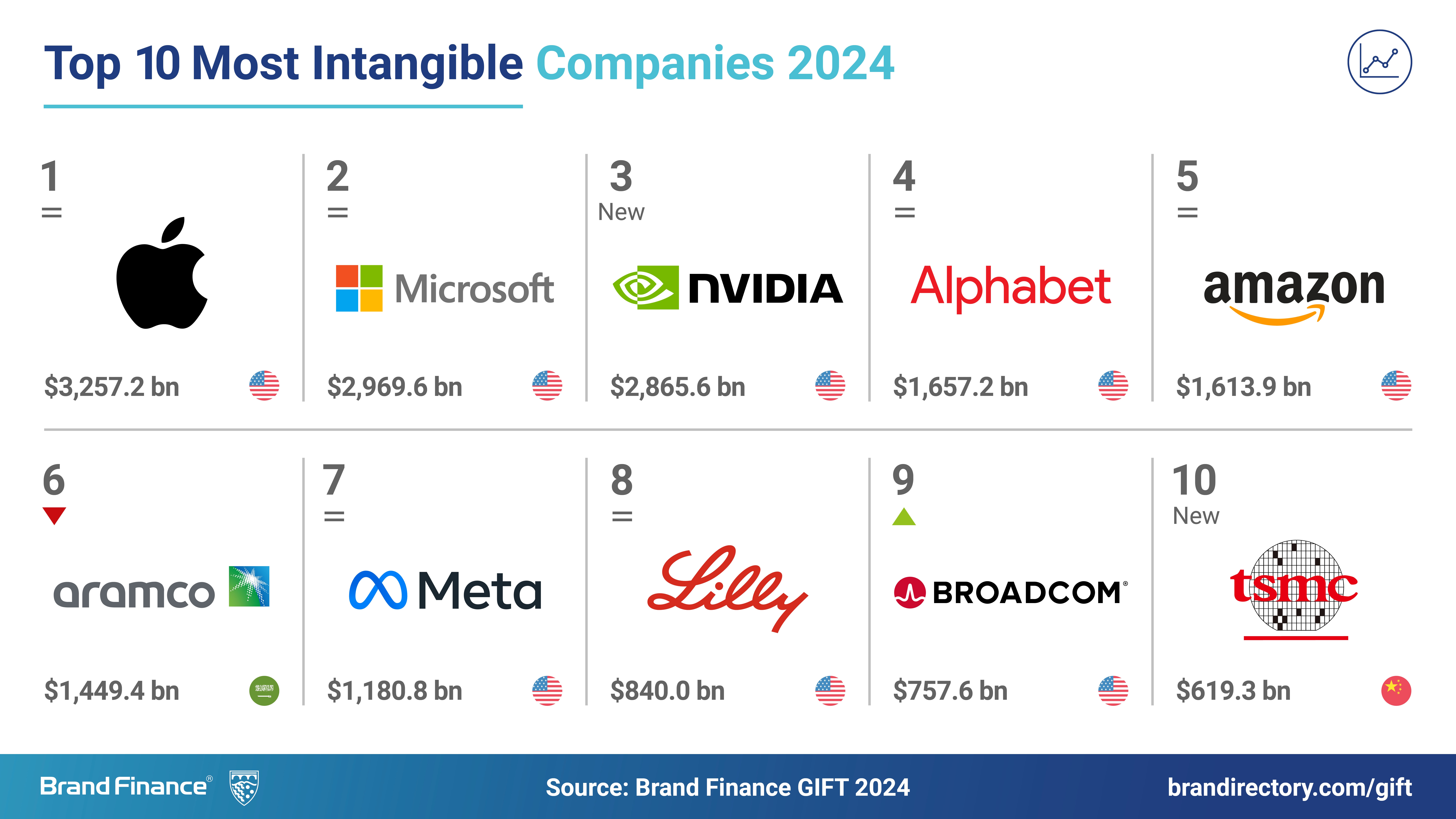
One can understand the importance of intangible asset from the following figure:

Valuation Methods for Intangible Assets in the Healthcare Industry
- The cost approach which determines an asset’s value based on the cost to replace it.
- The market approach derives an asset’s value from the prices paid in the marketplace for similar, or comparable assets.
Some properties of intangible assets:
- They are difficult to measure and quantify.
- Intangible assets have a finite life and require to be replaced periodically.
- They do not come up on the balance sheets.
- They add a hidden but huge value to the business.
Why is it important to develop a strong brand image?
- Mergers, Partnerships and Acquisitions: Now a days lots of hospitals are either merging with others or acquiring other healthcare businesses in order to expand their portfolio. So for this a strong branding is needed which will have a positive impact on others.
- Increase the market share and reduce financial burden: There are lots of government regulations, taxation and other policy changes, overall economic slowdown, constant pressure to cut down costs which is increasing financial pressure on the organizations. A strong brand provides the intangible asset of goodwill which will increase the valuation of the hospital as well as the market share.
- Strong healthcare brands control their own destinies.
- Provide security in volatile periods: Brand loyalty and goodwill is the biggest asset especially when the organization is going through crisis phase and a slow down. Strong brands can earn benefit of doubt and weaker brands with slip – ups are more likely to be called out.
- Good brands can demand higher price: People choose particular brands since its trustworthy and promising. If branding is powerful, then customers will be willing to pay more for the stronger brand than the lesser known brands. The brand not only allows the organization to be a preferred option, but it also commands higher price.
- Branding creates trust: Healthcare service decisions are very crucial decisions as compared to restaurants or flight selection or any other service industries. It’s the question of life and death and lots of emotional factors are involved in the decision making process. Before any patient decides to take up any kind of treatment from a doctor, a trust factor has to build up in between the two. Branding creates trust by delivering on brand promises and through relationship building.
- Employee satisfaction: Retaining good and talented staff is essential and it is possible by creating a strong brand image. High staff turnover rate can be detrimental for any organization and will affect the morale of other employees. A strong brand alongwith a clear mission and vision will definitely enhance employee ownership. Even employees feel that they are the part of the vision and mission of the hospital. So overall employee satisfaction increases.
- Patient satisfaction: Customer experience is the number one thing driving retention in business today, says Lindsay Neese Burton of Reputation.com, And a positive patient experience is more likely to increase the brand loyalty. The most effective factor which has highest influence on patient satisfaction is brand image, then comes staff sincerity and then comes physician’s rapport and interaction.
Therefore, a business needs to know how to best tell the story of its brand. Moreover, it is necessary to find out what factors influence consumers to gain their loyalty and to raise the business performance in return
Brand value is a very important intangible asset. For years we have known that Microsoft is Bill Gates and Apple is Steve Jobs. They have created a strong brand image and now those companies are run by their successors ie Satya Nadella and Tim Cook respectively. Now it is on them to sustain the brand image and make it more stronger. As our business keeps growing, one has to keep in mind that apart from our balance sheet and P/L statement figures , we have to constantly keep building a sustainable intangible asset which will help you to run a long race. It will help you to build a strong position in the market and the brand will have a lasting value.
Properties of strong intangible assets
- Build a strong customer base and more important it will attract loyal customers. Now a days it is very difficult to achieve customer loyalty. But a strong brand can help you do so.
- Will captivate and retain a larger market share.
- Will attract stakeholders and investors.
- Distinguish you from the competitors. If you wish to sustain for a long term, you need to build a strong intangible asset.
Although few brand names have become a synonym for their product (Kleenex, Xerox) or a verb (eg, please FedEx this package). Even for start ups and small businesses, brands have a significant role especially in forecasting sales and sustainability.
Why organizations remove the estimate and value of their intangible assets?
- For financing & taxation purposes.
- Dealing with acquisitions, mergers, collaborations or partnerships
- Royalty rates
- For litigation purposes
- During re-organization or bankruptcy
New and advanced HIMS is making patient data collection & analysis very easy and thus giving way to new type of intangible asset in healthcare. There is lots and lots of data which can be retrieved and analyzed which will be helpful in lots of decision making process.
Key Human Resources as an intangible asset for any organization
Be it Healthcare or any other organization, right mix of people, perfect pool of human resources are an intangible asset to the organization. It starts from recruitment , selection, identifying the correct personnel with the right KSAs (knowledge, skills and attitude ), training them, motivating them to deliver their best.
For example, in healthcare if you recruit a physician who is clinically sound, communicates well with the patients – then he is creating value by attracting and retaining new patients. Hire the right physician, so automatically patient base will increase. Hire a physician who is difficult to work with and chaos will follow.
Goodwill and a loyal customer base as an intangible asset
Is your hospital actually concerned about the patient’s needs and wants? Do you regularly take their feedback and try to improvise on it ? A customer focused hospital culture will gradually earn a strong goodwill. Findlaw defines godwill as a measure of your company’s reputation, and of how willing these individuals would be to continue doing business with your company.
In a monopoly market, when patients have no options, goodwill does not play a significant role. But in today’s competitive environment, goodwill will make your organization stand out. It will definitely have an impact on your topline.
Identifying intangible assets is the road to success. Managing those intangible assets keeps your business on track for sustainable success. Some intangible assets can be linked directly to a future stream of cash flows and valued on a standalone basis in a straight-forward manner. Drug patents are one such example.
References for Hospital Growth:
- Donabedian Model: Structure, Process, and Outcome for Healthcare Quality Assessment
- Healthcare Quality: Key Determinant for Improved Health Outcomes and Patient Satisfaction
- Explore case studies of Indian hospitals and how they built strong brands and long-term patient loyalty
About The Author


